
by Emmitt Barry, Worthy News Washington D.C. Bureau Chief
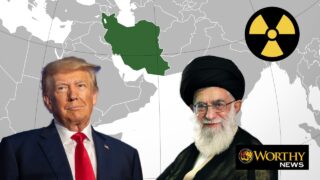
(Worthy News) – A military confrontation between the United States and Iran could erupt within days and develop into a sustained, multi-week campaign, according to multiple sources cited Wednesday, even as diplomatic talks continue between Washington and Tehran.
Sources told Axios that the likelihood of kinetic action in the coming weeks stands at roughly 90 percent, with one White House official suggesting preparations are well advanced. The potential conflict, described as possibly larger than last June’s 12-day Israeli-led bombing campaign, could involve a joint U.S.-Israeli operation. Iranian missile barrages during that June escalation killed 32 people in Israel and wounded more than 3,000.
Former Israel Defense Forces Military Intelligence chief Amos Yadlin warned that the region is closer to war than at any recent point. Speaking to Israel’s Channel 12, Yadlin said he would “think twice” about traveling abroad this weekend, signaling his assessment of heightened risk. However, he emphasized that superpowers do not enter war lightly and that diplomatic avenues must still be exhausted.
U.S. President Donald Trump is said to be increasingly frustrated with Tehran’s stance. While some advisers reportedly caution against war, others believe the president is nearing a decision. “All options are on the table,” officials reiterated, underscoring that the military posture in the region reflects a credible threat rather than rhetoric.
Israel appears to be preparing for rapid developments. Likud lawmaker Boaz Bismuth, chairman of the Knesset Foreign Affairs and Defense Committee, said the country faces “challenging days” and that both the public and authorities are preparing the home front for every scenario. Israeli officials reportedly believe Iran could retaliate directly against Israel in the event of a U.S. or joint strike.
The military buildup has accelerated. Open-source flight tracking data shows dozens of U.S. fighter jets — including F-22s, F-35s, and F-16s — repositioned to the Middle East within 24 hours, along with aerial refueling aircraft. Meanwhile, Iran announced joint naval exercises with Russia in the Sea of Oman and northern Indian Ocean, while the Islamic Revolutionary Guard Corps conducted drills in the strategic Strait of Hormuz, briefly closing portions of the waterway for “security” reasons.
Diplomatically, the picture remains murky. Following the latest round of nuclear talks in Geneva, Iran claimed agreement on “guiding principles” to avoid conflict. Yet U.S. officials offered a far more pessimistic assessment. White House press secretary Karoline Leavitt acknowledged “a little bit of progress” but said the sides remain “very far apart.” Vice President JD Vance and Energy Secretary Chris Wright reiterated that preventing Iran from obtaining nuclear weapons remains a non-negotiable red line.
Operation Midnight Hammer — the June strike U.S. officials say severely damaged Iranian nuclear facilities — has not ended the standoff. Senior officials now suggest Iran has until the end of the month to agree to significant concessions. “Timetables are growing shorter,” one Israeli official said, noting that in the end, the decision rests with the U.S. president.
As military assets shift into position and regional actors brace for possible retaliation, the Middle East stands at a precarious crossroads — with diplomacy still alive, but the drumbeat of war growing louder.
Prophetic Undercurrent: War Rumors, Elam, and the Shaking of Nations
With mounting U.S.–Iran tensions, rapid American fighter jet deployments, Israeli home-front preparations, and Iranian naval drills in the Strait of Hormuz, the region appears poised on the edge of a potentially historic confrontation. Military timetables are shortening. Diplomatic language is tightening. Leaders speak of red lines and decisive action.
Yet beneath the visible military calculus lies a quieter dimension—one many believers interpret through a prophetic framework.
While headlines focus on joint naval maneuvers, Revolutionary Guard exercises, and the possibility of a multi-week campaign involving the United States and Israel, another movement continues inside Iran itself. Despite surveillance, arrests, and increasing state pressure, Iran remains widely regarded as home to one of the fastest-growing underground Christian movements in the world. House churches multiply discreetly. Small gatherings meet without public buildings or official recognition. Testimonies persist of Muslims, secular Iranians, and former regime loyalists encountering Scripture in private and coming to faith.
The Bible speaks with striking specificity about this region, framing its future within the language of the אַחֲרִית הַיָּמִים (acharit ha-yamim)—“the latter days,” often understood in prophetic theology as the end of days or even the end of the end of days. The ancient territory of Elam—corresponding largely to modern southwestern Iran—is directly addressed in Book of Jeremiah 49:34–39.
The prophet begins with a decisive declaration: the Lord will “break the bow of Elam.” In biblical symbolism, the bow represents military strength, strategic reach, and national security. To break the bow is to dismantle a nation’s capacity to project power. The passage continues with language of scattering, fear, and upheaval among leadership structures—imagery consistent with systemic destabilization rather than isolated political disruption.
Yet the prophetic word does not terminate in judgment. It pivots. After describing the humbling of Elam’s military and governing authority, the Lord declares, “But I will restore the fortunes of Elam in the latter days.” The Hebrew phrase situates this restoration within an eschatological horizon — acharit ha-yamim — a time frame associated with climactic redemptive purposes in Scripture.
The pattern is consistent with broader biblical prophecy: dismantling precedes rebuilding; the breaking of the bow precedes the mending of destiny. National shaking becomes the corridor to divine reordering. Judgment is not portrayed as annihilation, but as a severe mercy that clears the ground for restoration.
The pattern is striking. National shaking at the top. Restoration is promised in the aftermath. Power structures confronted. A future beyond upheaval.
In the current moment—where the article outlines U.S. fighter jets repositioning, Israeli officials bracing for retaliation, and Iran signaling strength through maritime drills—many see the convergence of geopolitical pressure and spiritual stirring. Scripture often presents crisis not merely as punishment, but as refinement. When regimes harden, hearts sometimes soften. When global attention fixates on military escalation, quieter transformations may unfold beneath the surface.
It is notable that periods of heightened repression in Iran have frequently coincided with spiritual awakening. Political tightening has not extinguished faith; in many accounts, it has accelerated it. Digital blackouts cannot prevent whispered prayer. Military mobilization cannot silence personal conviction. Pressure on a nation’s external defenses often exposes deeper internal hunger.
None of this diminishes the seriousness of the potential conflict described in the article. A U.S.–Iran confrontation would carry enormous human and strategic consequences. Yet, when viewed biblically, prophecy rarely stops at conflict. It moves through judgment toward restoration. The shaking of Elam is not the end of Elam’s story.
As aircraft carriers maneuver and deadlines approach, observers of both geopolitics and Scripture are watching two fronts simultaneously: the visible military theater in the Gulf—and the invisible spiritual movement within Iran’s borders.
History shows that while wars reshape maps, awakenings reshape destinies—prophetically, we may be witnessing the awakening of Elam (Iran).
Copyright 1999-2026 Worthy News. This article was originally published on Worthy News and was reproduced with permission.
Latest News from Worthy News

Americans added another $21 billion in credit card debt during the second quarter of 2026, pushing outstanding balances to roughly $1.26 trillion and bringing consumer borrowing close to its record high.

Israel is moving to expand the use of autonomous strike systems across its frontline forces, awarding a new Defense Ministry contract to develop a next generation of low-cost tactical attack drones for the Israel Defense Forces.

The United States has publicly rejected Israeli Defense Minister Israel Katz’s declaration that Israeli troops will remain in southern Lebanon for the long term, exposing a widening disagreement between Washington and Jerusalem over how to secure Israel’s northern border.

Millions across Europe watched Wednesday as a rare total solar eclipse swept across the northern Atlantic and portions of the continent, an extraordinary celestial event unfolding just hours before the biblical calendar entered Elul — the month traditionally associated with repentance, spiritual preparation and the approach of the King.

The State Department has launched a new task force targeting “birth tourism” networks accused of exploiting U.S. immigration laws to secure American citizenship for children born to foreign nationals visiting the United States.

More details have emerged about an extraordinary secret flight by U.S. President Donald J. Trump, who was reportedly moved between aircraft inside a catering truck amid fears of an Iranian attempt on his life.

Russian attacks across Ukraine killed at least 12 people and wounded dozens more, Ukrainian officials said Wednesday, as Kyiv accused Moscow of using North Korean ballistic missiles in its escalating air campaign.