
by Emmitt Barry, Worthy News Washington D.C. Bureau Chief
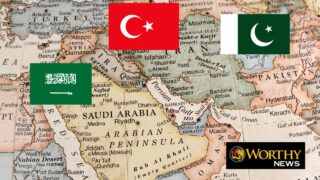
(Worthy News) -(Worthy News) – Turkey is seeking to join an existing defense alliance between Pakistan and the Kingdom of Saudi Arabia, a move that could lay the groundwork for a new regional military bloc modeled loosely on the North Atlantic Treaty Organization (NATO), according to a report published Friday by Bloomberg.
The current Saudi-Pakistan defense agreement includes a collective defense clause stating that any aggression against one member would be treated as an attack on all. The provision closely mirrors NATO’s Article 5, which has long served as the cornerstone of mutual defense among Western allies.
Turkey, which joined NATO in 1952 and maintains the alliance’s second-largest standing army after the United States, is reportedly in advanced talks to enter the pact. Bloomberg cited sources familiar with the discussions who said a deal is “very likely.”
The move aligns with repeated statements from Turkish President Recep Tayyip Erdoğan, who has publicly called for the creation of an Islamic alliance to counter Israeli “aggression” and has increasingly distanced Ankara from U.S. and NATO positions in the Middle East. Erdoğan has pursued a foreign policy aimed at reducing Turkey’s reliance on Western powers while expanding its influence across the Sunni Muslim world.
Nihat Ali Özcan, a strategist at the Ankara-based think tank TEPAV, told Bloomberg that shifting regional dynamics are driving countries to seek new security arrangements outside traditional Western frameworks. “As the US prioritizes its own interests and that of Israel in the region, changing dynamics and fallout from regional conflicts are prompting countries to develop new mechanisms to identify friends and foes,” Özcan said.
Turkey has already deepened ties with Pakistan through growing economic and military cooperation. Last year, Ankara signed a $300 million hydrocarbon exploration agreement with Islamabad and expanded collaboration in drone development, naval modernization, intelligence sharing, and defense production. Turkish firms are manufacturing some of Pakistan’s naval vessels, and Ankara is reportedly seeking to establish drone production facilities inside Pakistan. Turkey has also encouraged Pakistan to participate in its next-generation KAAN fighter jet program.
Özcan noted that a trilateral alliance would combine distinct strengths: Turkey’s battle-tested military and rapidly expanding defense industry, Saudi Arabia’s economic power, and Pakistan’s nuclear deterrent, ballistic missile capabilities, and large manpower base. Pakistan is the only nuclear-armed state in the Muslim world.
Reuters reported Friday that Pakistan is nearing a $1.5 billion arms deal with Sudan’s army, which is backed by both Saudi Arabia and Turkey and is fighting the UAE-supported Rapid Support Forces. The deal reportedly includes Karakorum-8 light-attack aircraft, more than 200 reconnaissance and kamikaze drones, advanced air-defense systems, and potentially JF-17 fighter jets. Retired Pakistani Air Marshal Aamir Masood described the agreement as a “done deal.”
If finalized, a Saudi-Pakistan-Turkey defense pact would link three of the region’s most influential states. Saudi Arabia is the Arab world’s only G-20 economy and custodian of Islam’s two holiest cities, Mecca and Medina. Pakistan brings nuclear capability, while Turkey straddles Europe and Asia with NATO’s second-largest army and a globally recognized drone program that has already been used by Ukraine against Russia.
However, some analysts warn that Turkey’s entry into such a pact could advance Erdoğan’s long-suspected ambition of acquiring nuclear weapons. Saudi Arabia, which has sought U.S. support for a civilian nuclear program while signaling it may pursue nuclear arms if regional rivals do so, could also look to Pakistan’s nuclear infrastructure to maintain strategic deterrence.
Israeli officials would likely view nuclear ambitions by either Turkey or Saudi Arabia as an existential threat. Israel has previously taken military action to prevent regional adversaries from acquiring nuclear weapons, including strikes in Iraq, Syria, and covert operations targeting Iran.
The shifting alliance structure underscores broader changes in the Middle East. While Turkey and Saudi Arabia were once fierce rivals for leadership of the Sunni Muslim world, relations began improving around 2021. The two countries now find themselves aligned in conflicts such as Syria and Sudan, even as Saudi Arabia’s partnership with the United Arab Emirates has fractured amid competing interests in Yemen and beyond.
As regional powers reassess alliances amid ongoing wars in Gaza, Lebanon, Syria, and tensions with Iran, the emergence of a new Muslim-led defense bloc could significantly reshape the Middle East’s security architecture.
Prophetical Implications
From a biblical prophecy perspective, the emergence of new military alliances among predominantly Muslim nations is viewed by many Christian and Jewish observers as aligning with long-standing scriptural warnings about nations ultimately turning against Israel. Passages such as Psalm 83, Ezekiel 38–39, and Zechariah 12 describe a future convergence of regional powers hostile to Israel, forming coalitions that seek to challenge its security and existence. While interpretations differ on timing and participants, the growing coordination between Turkey, Saudi Arabia, and Pakistan is seen by some as part of a broader realignment in which traditional restraints fade and opposition to Israel becomes more unified, strategic, and militarized.
Scripture also emphasizes that these developments do not unfold in a vacuum. The prophetic narrative consistently points to a season in which Israel becomes a focal point of global tension, even as alliances shift and new power blocs arise. Yet those same passages underscore divine sovereignty, portraying Israel not as abandoned but as preserved through escalating pressure. For believers, the rise of such alliances serves as a reminder of Yeshua’s (Jesus’) words that nations would rage and alliances would form, but that these events ultimately move history toward God’s redemptive purposes rather than away from them.
Copyright 1999-2026 Worthy News. This article was originally published on Worthy News and was reproduced with permission.
Latest News from Worthy News
Israeli Prime Minister Benjamin Netanyahu issued a blunt warning to Turkey on Wednesday after Israel struck a Syrian military airbase that Jerusalem says Ankara was preparing to use for an expanded military presence in Syria.

Democratic socialist Angie Nixon scored a surprise victory Tuesday in Florida’s Democratic U.S. Senate primary, defeating heavily funded establishment favorite Alex Vindman and adding to a growing series of socialist and far-left victories reshaping Democratic politics across the country.

The United States government passed a sobering milestone Wednesday as the national debt topped $40 trillion, up from $39 trillion only five months ago.

The U.S. Department of Justice plans to deploy approximately 1,000 federal election monitors across the country for November’s midterm elections, marking what officials say will be a record-sized monitoring operation.
President Donald Trump announced what he called an “Economic D-Day” against Iran on Wednesday, warning that countries, banks, businesses and governments that continue providing Tehran with economic lifelines could themselves face severe U.S. consequences.

President Donald Trump has paused sweeping 50% tariffs on roughly $20 billion in Canadian imports for three days, giving Washington and Ottawa additional time to finalize what Trump says is a new trade agreement between the neighboring countries.

At least nine people, including five Bangladeshi nationals and a child, were killed Wednesday when fire and thick smoke swept through a building housing several hotels in Kolkata, highlighting broader concerns about lax enforcement of fire-safety regulations in one of the world’s most densely populated cities and across India.