
by Stefan J. Bos, Worthy News Chief International Correspondent
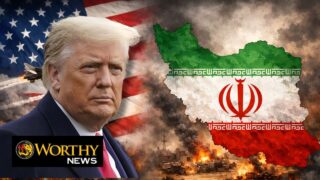
WASHINGTON/JERUSALEM/TEHRAN (Worthy News) – In a setback to those hoping for regime change in the Islamic Republic, U.S. President Donald J. Trump signaled Friday that he may begin “winding down” military operations against Iran, saying Washington is close to achieving its objectives.
He also warned allies frustrated over rising energy costs that they would have to take responsibility for reopening the Strait of Hormuz themselves.
“The Hormuz Strait will have to be guarded and policed, as necessary, by other nations that use it — the United States does not!” Trump said.
“If asked, we will help these countries in their Hormuz efforts, but it shouldn’t be necessary once Iran’s threat is eradicated. Importantly, it will be an easy military operation for them,” he added.
The strait, a critical waterway for global oil shipments carrying roughly a fifth of the world’s supply, has been severely disrupted since hostilities began, with Iran threatening shipping using sea mines, drones, and missiles.
TRUMP FRUSTRATED OVER RELUCTANCE
Trump has expressed frustration over the reluctance of NATO allies to participate directly in securing the waterway, raising concerns about burden-sharing within the Western alliance.
European nations and Japan have said they are ready to support efforts to improve security in the Strait of Hormuz, as the war with Iran continues to disrupt shipping without a clearly defined military role.
In a joint statement, Britain, France, Germany, Italy, the Netherlands, and Japan condemned attacks on commercial vessels and said they were prepared to “contribute to appropriate efforts” to help ensure safe passage and stabilize global energy markets.
However, the statement did not specify how these contributions would be implemented or the extent of resources that would be committed.
Despite the tensions, maritime data shows the strait has not been completely shut, with roughly 90 vessels — including oil tankers — crossing in the first two weeks of March, far below normal levels but indicating limited traffic continues.
SELECTIVE SHIPPING, EUROPE DIVISIONS
Analysts say the strait is now operating selectively, with some vessels allowed passage while others face heightened risks, contributing to volatility in global supply chains.
There are signs of increased Western naval activity: Britain has expanded patrols in the Gulf, while France has signaled readiness to support maritime security operations.
Germany, however, has ruled out direct military involvement, underscoring divisions within Europe over how to respond to the crisis.
The lack of a unified Western military strategy has raised questions about Europe’s readiness to secure key global trade routes after years of relatively low defense spending.
Yet uncertainty over the safety of key shipping lanes continues to weigh on global markets and investor confidence.
MARKETS SHAKE AS OIL PRICES SURGE
Trump’s remarks came as stocks and bonds sold off simultaneously, signaling growing investor concern that the conflict may last longer than previously expected.
The S&P 500 index, which tracks major U.S. companies, extended its longest weekly losing streak in a year, reflecting fears of prolonged economic disruption linked to the Iran conflict.
Gold — typically seen as a safe haven — headed for its worst week since 1983, highlighting unusual cross-market volatility that analysts say reflects confusion over future monetary policy and geopolitical risks.
“Since Operation Epic Fury began nearly three weeks ago, markets have broadly clung to a comforting bet: that disruption to oil supply would be brief, the Strait of Hormuz would reopen, and the Federal Reserve’s easing cycle would resume. On Friday, that bet broke,” financial news service Bloomberg News commented.
Oil prices surged above 110 dollars per barrel amid fears of prolonged disruption, pushing gasoline and diesel prices sharply higher in the United States and adding political pressure on the administration.
IRAN LEADERSHIP STILL HOLDS FIRM
The financial and energy turmoil comes as Tehran hardens its position, with intelligence suggesting the Islamic Republic’s leadership is unlikely to step aside despite sustained military pressure.
Western intelligence assessments indicate Iran’s leadership “remains cohesive,” reducing expectations of any near-term collapse of the ruling system, Worthy News learned.
Officials say U.S. and Israeli strikes have killed several senior Iranian security and military figures in recent weeks, including officials linked to the killing of thousands of protesters, though exact casualty figures remain unclear.
Among those reported killed are senior official Ali Larijani, Basij commander Gholamreza Soleimani, IRGC spokesman Ali Mohammad Naini, and Basij intelligence chief Ismail Ahmadi.
The Basij is a paramilitary force used to enforce internal control, while the Islamic Revolutionary Guard Corps (IRGC) is an elite military organization tasked with protecting Iran’s ruling system and directing key security operations.
MIXED SIGNALS FROM WASHINGTON
Trump has also kept open the possibility of deploying U.S. ground forces, even as he claims key objectives — including degrading Iran’s missile capabilities and military infrastructure — are close to being achieved.
Separately, U.S. officials are weighing options involving Iran’s key oil export hub on Kharg Island, including scenarios in which hundreds of U.S. Marines could be deployed to secure strategic energy infrastructure, according to sources familiar with the planning.
Critics say such a move would mark a significant escalation, even as the administration publicly signals a potential de-escalation of the broader conflict.
Analysts warn that the perceived mixed messaging from Washington has added to volatility in global markets and increased uncertainty among U.S. allies already grappling with rising oil prices and heightened security risks in the Gulf.
Copyright 1999-2026 Worthy News. This article was originally published on Worthy News and was reproduced with permission.
Latest News from Worthy News

Americans added another $21 billion in credit card debt during the second quarter of 2026, pushing outstanding balances to roughly $1.26 trillion and bringing consumer borrowing close to its record high.

Israel is moving to expand the use of autonomous strike systems across its frontline forces, awarding a new Defense Ministry contract to develop a next generation of low-cost tactical attack drones for the Israel Defense Forces.

The United States has publicly rejected Israeli Defense Minister Israel Katz’s declaration that Israeli troops will remain in southern Lebanon for the long term, exposing a widening disagreement between Washington and Jerusalem over how to secure Israel’s northern border.

Millions across Europe watched Wednesday as a rare total solar eclipse swept across the northern Atlantic and portions of the continent, an extraordinary celestial event unfolding just hours before the biblical calendar entered Elul — the month traditionally associated with repentance, spiritual preparation and the approach of the King.

The State Department has launched a new task force targeting “birth tourism” networks accused of exploiting U.S. immigration laws to secure American citizenship for children born to foreign nationals visiting the United States.
More details have emerged about an extraordinary secret flight by U.S. President Donald J. Trump, who was reportedly moved between aircraft inside a catering truck amid fears of an Iranian attempt on his life.

Russian attacks across Ukraine killed at least 12 people and wounded dozens more, Ukrainian officials said Wednesday, as Kyiv accused Moscow of using North Korean ballistic missiles in its escalating air campaign.