
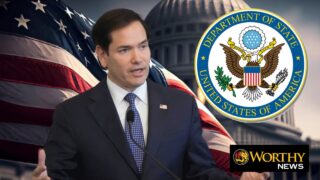
by Stefan J. Bos, Worthy News Europe Bureau Chief reporting from Budapest, Hungary
BUDAPEST (Worthy News) – The United States and Hungary have concluded 17 agreements covering nuclear energy, oil, and natural gas cooperation as Budapest faces pressure to reduce its reliance on cheap Russian energy.
Hungarians will once again qualify for visa-free travel to the United States, Prime Minister Viktor Orbán confirmed after talks with U.S. Secretary of State Marco Rubio in Budapest on Monday.
The agreements were announced as Rubio delivered a strong endorsement of Orbán ahead of Hungary’s closely contested April 12 parliamentary election, saying President Donald J. Trump is committed to the Hungarian leader’s success.
“President Trump is deeply committed to your success, because your success is our success,” Rubio said, standing beside Orbán. “We want this country to do well. It’s in our national interest, especially as long as you’re the prime minister.”
Rubio added that U.S.–Hungarian relations are entering a “golden era,” citing both policy alignment and Orbán’s “extraordinarily strong” relationship with Trump, which he said has produced tangible benefits for bilateral ties.
U.S. SIGNALS POTENTIAL FINANCIAL SUPPORT
Rubio also indicated Washington would be prepared to assist Hungary financially if necessary — remarks that come as Budapest remains cut off from billions of euros in European Union funding over rule-of-law concerns.
“If you face financial struggles… I know President Trump will be very interested… in finding ways to provide assistance,” Rubio said.
The comments appeared aimed at countering claims that Hungary is isolated within the European Union. Rubio insisted the country is “clearly not isolated.”
The diplomatic backing comes as Orbán’s ruling Fidesz party faces its strongest challenge since returning to power in 2010. Opinion polls show the opposition Tisza Party, led by Péter Magyar, running competitively, with roughly a 10 percent lead among decided voters.
Orbán acknowledged electoral uncertainty, noting he is not only Hungary’s longest-serving prime minister but also spent 16 years in opposition.
ELECTION WITH BROADER EUROPEAN IMPLICATIONS
“Sometimes you win, sometimes you lose,” Orbán said, maintaining that Hungarian democracy remains strong and rooted in competitive elections over the past 35 years.
“The next government will be formed according to the will of the people, and Hungary will remain a strong country regardless of the election outcome,” he added.
The April vote is widely seen as significant beyond Hungary, potentially shaping Europe’s strengthening conservative and nationalist movements. Ahead of the ballot, Budapest will organize the fifth Hungarian edition of the Conservative Political Action Conference (CPAC), loosely associated with the U.S.-based CPAC events, bringing together nationalist and right-wing leaders and activists.
Israeli Prime Minister Benjamin Netanyahu is reported to be among the international speakers at the March 21 conference.
Orbán, long one of Trump’s closest allies in Europe, has often clashed with Brussels over migration, judicial reforms, media laws, and anti-corruption standards — disputes that have led to the suspension of EU funds.
He has accused European Union institutions of politically targeting his government over its Christian-oriented family policies, tough migration stance, and opposition to what it views as LGBTQ+ ideology directed at children — positions that critics say undermine minority rights.
ENERGY, ECONOMY, AND GEOPOLITICS
Hungary’s economy has struggled since inflation surged following Russia’s 2022 invasion of neighboring Ukraine, with growth stagnating for three years.
Orbán’s government has cut taxes, raised wages, and promoted subsidized home loans to boost domestic demand — measures critics warn could widen the budget deficit and fuel inflation while Hungary maintains one of the European Union’s highest debt levels.
Rubio’s visit followed stops in Slovakia and the Munich Security Conference, where he emphasized transatlantic unity while maintaining criticism of some European policies.
He stressed that Hungary’s election outcome is for voters to decide, while repeatedly underscoring the strategic value Washington places on Orbán’s leadership.
Analysts suggest that whether the promised “golden era” materializes will ultimately depend on both Hungary’s economic trajectory and the verdict of voters in April.
Copyright 1999-2026 Worthy News. This article was originally published on Worthy News and was reproduced with permission.
Latest News from Worthy News

The State Department has launched a new task force targeting “birth tourism” networks accused of exploiting U.S. immigration laws to secure American citizenship for children born to foreign nationals visiting the United States.
More details have emerged about an extraordinary secret flight by U.S. President Donald J. Trump, who was reportedly moved between aircraft inside a catering truck amid fears of an Iranian attempt on his life.

Russian attacks across Ukraine killed at least 12 people and wounded dozens more, Ukrainian officials said Wednesday, as Kyiv accused Moscow of using North Korean ballistic missiles in its escalating air campaign.

Switzerland’s government has rejected a campaign to enshrine a stricter interpretation of the Alpine nation’s centuries-old neutrality in the constitution, ahead of a nationwide referendum next month.

An Indonesian and three Pakistani crew members were among six people killed in an attack by Iran-backed Houthi forces on a cargo ship in the strategic Bab el-Mandeb Strait near Yemen, officials said Wednesday.

Wim de Goeij, a former Jehovah’s Witness who became a prominent Dutch publisher of Bible-teaching materials and outspoken critic of the Watch Tower Society, has died. He was 64.
Hungary’s Parliament elected former Supreme Court President András Baka as the nation’s new president Tuesday, marking a dramatic political comeback for a judge removed from office under former Prime Minister Viktor Orbán.