
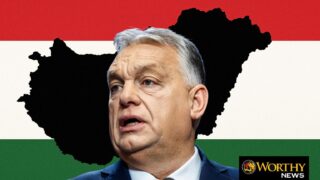
by Stefan J. Bos, Worthy News Europe Bureau Chief reporting from Budapest, Hungary
BUDAPEST (Worthy News) – Hungary’s prime minister has begun sending letters to households promising relief on energy bills ahead of April elections as wars in Ukraine and the Middle East raise fears of rising energy prices across Europe.
Viktor Orbán, who faces what analysts describe as his toughest electoral challenge since returning to power 16 years ago, said the government introduced a temporary “rezsistop,” or utility cost cap, after Hungary experienced its coldest January in about fifteen years.
His letter, also sent to the Worthy News Europe Bureau near the Russian Embassy in Budapest, says “the national government, even in wartime, ensures security for families through reduced utility prices.”
Orbán also refers to the war in Ukraine raging since Russia’s full-scale invasion in February 2022, writing that Hungary uses its economic resources “to support Hungarian families, not to finance Ukraine.”
LETTERS SENT AHEAD OF ELECTION
The letters arrive weeks before Hungary’s April 12 parliamentary elections, with opinion polls showing Orbán’s ruling Fidesz party trailing the opposition Tisza party led by Péter Magyar.
Officials say the unusually cold weather forced households to use significantly more heating during January.
The government says it will absorb part of the additional gas costs, effectively offering price cuts of up to 30 percent on extra consumption during the coldest period.
The measure is part of Hungary’s long-running system of regulated household utility prices.
MIXED POLITICAL REACTIONS
Magyar accused the government of using energy policy as a campaign tool.
“Gasoline prices are higher than, for instance, in Austria or Poland due to Orbán’s taxes,” he said, urging the government to reduce fuel taxes.
However, Magyar has also said that, if elected, he would maintain the cuts to public utility bills, known in Hungary as “rezsicsökkentés.”
Some voters voiced support for the measure.
“This was a very cold winter. I don’t mind that they say it is propaganda ahead of the elections. This helps people,” Budapest domestic worker Klara Rózsa told Worthy News.
PIPELINE DISPUTE WITH UKRAINE
Energy security has become a central issue in Hungary’s campaign.
Hungary and Slovakia have accused Kyiv of using energy supplies as a political weapon to obtain concessions, including support for Ukraine’s European Union membership, which both governments oppose.
Ukrainian officials deny blackmailing their neighbors, saying oil flows were halted after Russian attacks damaged sections of the Soviet-era Druzhba (“Friendship”) pipeline infrastructure and that repairs have taken longer than expected.
The pipeline remains a crucial route for Russian oil deliveries to Hungary and Slovakia.
GLOBAL ENERGY RISKS
The debate has intensified as fighting involving Iran raises fears of disruptions to global energy supplies.
Energy traders worry escalating tensions in the Middle East could affect shipments through the Strait of Hormuz, a route for roughly one-fifth of global oil and liquefied natural gas exports.
For Central and Eastern Europe — heavily dependent on imported energy — such disruptions could push prices higher and increase political pressure on governments.
That uncertainty has elevated the political importance of energy policy in Hungary’s election campaign.
CONSERVATIVES DEFEND ORBAN
Hungarian conservative magazine Hungarian Conservative argued that the geopolitical turmoil may actually strengthen Orbán politically.
“The politics and the economics of the situation are quite different here,” the publication wrote.
“Typically, a sharp rise in energy prices would hurt the incumbent party. But in Hungary, this election cycle, that may not be the case because Orbán has made energy security a core plank of his platform.”
The magazine noted that Orbán has repeatedly warned Brussels that abandoning Russian pipeline energy after the Ukraine war — particularly following the destruction of the Nord Stream pipeline in 2022 — could expose Europe to higher prices and supply risks.
“I TOLD YOU SO” MOMENT?
According to the analysis, instability in the Middle East and Europe’s growing reliance on liquefied natural gas imported from global markets, including the Middle East, may reinforce Orbán’s warnings.
“The situation that is developing in the Middle East is proving Orbán right,” the publication wrote.
It suggested that the Hungarian leader could now return to Brussels and effectively say “I told you so,” after years of warning that Europe’s energy strategy — particularly the shift away from Russian pipeline imports — risked exposing the continent to geopolitical shocks.
As Hungary approaches what could be its most competitive election in more than a decade, the debate over energy security, global conflicts and household subsidies is expected to remain central to the campaign.
Copyright 1999-2026 Worthy News. This article was originally published on Worthy News and was reproduced with permission.
Latest News from Worthy News

Americans added another $21 billion in credit card debt during the second quarter of 2026, pushing outstanding balances to roughly $1.26 trillion and bringing consumer borrowing close to its record high.

Israel is moving to expand the use of autonomous strike systems across its frontline forces, awarding a new Defense Ministry contract to develop a next generation of low-cost tactical attack drones for the Israel Defense Forces.

The United States has publicly rejected Israeli Defense Minister Israel Katz’s declaration that Israeli troops will remain in southern Lebanon for the long term, exposing a widening disagreement between Washington and Jerusalem over how to secure Israel’s northern border.

Millions across Europe watched Wednesday as a rare total solar eclipse swept across the northern Atlantic and portions of the continent, an extraordinary celestial event unfolding just hours before the biblical calendar entered Elul — the month traditionally associated with repentance, spiritual preparation and the approach of the King.

The State Department has launched a new task force targeting “birth tourism” networks accused of exploiting U.S. immigration laws to secure American citizenship for children born to foreign nationals visiting the United States.

More details have emerged about an extraordinary secret flight by U.S. President Donald J. Trump, who was reportedly moved between aircraft inside a catering truck amid fears of an Iranian attempt on his life.

Russian attacks across Ukraine killed at least 12 people and wounded dozens more, Ukrainian officials said Wednesday, as Kyiv accused Moscow of using North Korean ballistic missiles in its escalating air campaign.