
by Worthy News Jerusalem Bureau Staff
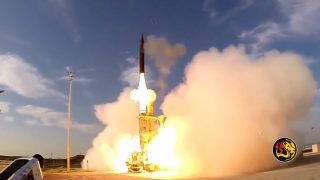
(Worthy News) – Israel’s renowned Arrow missile defense system is poised to enter a new era as the Ministry of Defense and Israel Aerospace Industries (IAI) prepare to roll out the next-generation Arrow 4 interceptor, designed to counter emerging threats including hypersonic glide vehicles (HGVs) and advanced ballistic missiles.
Jointly developed with the U.S. Missile Defense Agency, Arrow 4 marks a significant evolution in Israel’s multi-layered air defense capabilities. Unlike previous generations, Arrow 4 will operate in both exo-atmospheric and endo-atmospheric environments, enabling it to intercept a broader range of incoming threats — from reentry vehicles to maneuverable hypersonic warheads.
The new system is expected to enter production in the coming days, replacing the aging Arrow 2 system while complementing Arrow 3, which has been active since 2017. Arrow 4’s interceptor is specifically designed to counter the next generation of threats, including nuclear-capable hypersonic glide vehicles now being developed by China and Russia, according to a 2024 report from the Congressional Research Service.
Boaz Levy, CEO of Israel Aerospace Industries, told Business Insider that IAI had been applying real-time battlefield data to improve the Arrow systems throughout Israel’s recent clashes with Iran and its proxies. “We do have lessons learned about system operation, about threat capabilities, and more,” Levy said, describing the development strategy as a “building blocks mechanism.”
Arrow systems have been at the forefront of Israel’s defense during recent large-scale attacks, particularly the 12-day war with Iran known as Operation Rising Lion. That conflict, which began on June 13, saw over 550 ballistic missiles and 1,000 drones launched at Israel. According to Levy, Arrow interceptors neutralized more than 90% of the ballistic missile threats they targeted.
The Arrow 3 system, already field-proven against Iranian threats and Houthi-launched missiles from Yemen, is being deployed internationally as well. Germany has finalized the largest defense export deal in Israel’s history to acquire the Arrow 3 system. Officials from both nations have begun joint preparations for delivery, including site construction at Holzdorf Air Base, where Germany’s first Arrow 3 battery will be stationed.
Lt.-Gen. Ingo Gerhartz, the outgoing commander of the German Air Force, accepted initial Arrow components during a visit to Israel in May, just days before a Houthi missile struck near Ben-Gurion International Airport. Germany’s deployment will provide its military with the unprecedented ability to intercept threats at altitudes of up to 100 kilometers — entering near-space territory that had previously been undefended.
The Arrow systems, developed in cooperation with Boeing, are part of Israel’s top-tier missile defense network, which also includes Iron Dome, David’s Sling, and Patriot batteries. In the April 2024 and October 2024 missile salvos launched by Iran, the Arrow systems intercepted the vast majority of threats, protecting critical infrastructure and population centers.
U.S. forces in the region, including Navy destroyers equipped with Aegis systems, THAAD units, and Patriot batteries, have worked in coordination with Israeli air defenses during these confrontations. American forces also supported Israel’s retaliatory campaign last month, striking Iranian nuclear facilities using stealth bombers and submarines. Iran responded by targeting a major U.S. base in Qatar, though those missiles were intercepted.
President Donald Trump announced a ceasefire agreement between Israel and Iran several days after the latest exchange of hostilities, which appears to be holding for now.
“Arrow 4 isn’t just another upgrade,” Levy emphasized. “It’s a major leap forward in our ability to face new threats in real time, with allies by our side.”
As Israel and its partners continue to adapt to an evolving missile landscape, Arrow 4 is set to become a cornerstone of strategic defense not just for the Jewish state, but for its allies facing the increasing challenge of long-range, high-speed aerial threats.
Copyright 1999-2026 Worthy News. This article was originally published on Worthy News and was reproduced with permission.
Latest News from Worthy News

Romania and neighboring Hungary are facing an energy crisis linked to a record heat wave and the related low level of the Danube River, with Romania forced to shut down its last operating nuclear reactor while Hungary struggles to keep the only one of its four Paks reactors still operating online.

An elderly Christian leader has been detained in India for allegedly offending the religious sentiments of the Asian nation’s Hindu majority on social media.

Members of Pakistan’s Christian minority were reeling Friday after numerous violent incidents over faith and what they say were false allegations of blasphemy against Islam, the majority religion in the Asian nation.

The number of Americans filing for unemployment benefits remained relatively low in early August, offering another sign that widespread layoffs have yet to take hold even as hiring across the U.S. economy remains subdued.

The Israel Defense Forces (IDF) carried out a second preemptive airstrike in Gaza in two days Thursday, targeting a Hamas terror cell in Khan Yunis that Israeli military officials said was preparing an attack against Israeli forces.

The Trump administration has announced nearly $2 billion in health and humanitarian assistance for faith-based organizations, placing several major Christian ministries at the center of a reshaped U.S. foreign-aid strategy following sweeping cuts to USAID programs.

Hungarian Prime Minister Péter Magyar has cast doubt on a controversial Russian-led expansion of Hungary’s only nuclear power plant after record-low levels of the Danube River nearly forced its existing reactors into a complete shutdown.