
by Emmitt Barry, Worthy News Washington D.C. Bureau Chief
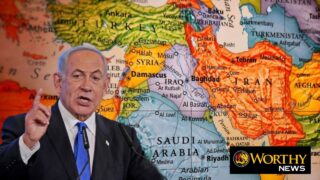
(Worthy News) – Israel and the United States are increasingly targeting Iran’s internal security apparatus as part of their ongoing military campaign, striking organizations responsible for suppressing protests and maintaining the Islamic Republic’s grip on power.
According to a report by the The Wall Street Journal, Israeli airstrikes have focused on elements of Iran’s domestic enforcement network, including the Basij paramilitary force and senior intelligence officials. U.S. forces have also struck facilities tied to the Islamic Revolutionary Guard Corps (IRGC), including its headquarters in Tehran.
These security forces were central to the brutal crackdown on anti-government protests earlier this year. During demonstrations in January, IRGC units, Basij militants, and police forces opened fire on crowds and carried out mass arrests in what analysts describe as one of the deadliest political crackdowns in decades.
Israeli officials say the strategy is intended to weaken Iran’s “police state” from the air, potentially allowing internal opposition movements to challenge the regime on the ground. Among the targets was the IRGC’s Tharallah headquarters, a command center used to coordinate intelligence, policing, and Basij units during times of unrest.
Israeli aircraft also struck the special-units headquarters of Iran’s police command, known as Faraja, which oversees riot control and the suppression of civil unrest. Iranian authorities later confirmed the death of Faraja intelligence chief Golamreza Rezaian following the strike.
Joint U.S.–Israeli strikes have also targeted security installations in Iran’s Kurdish regions, long considered centers of anti-regime sentiment. In the city of Sanandaj, attacks reportedly hit police stations and detention centers run by Iranian intelligence and the Revolutionary Guard.
President Donald Trump has also called on Iranian security forces to abandon the regime, urging members of the IRGC, military, and police to defect and accept immunity.
Analysts caution, however, that airstrikes alone may not be enough to topple Iran’s government. While widespread unrest has simmered across the country, the regime still maintains tight control over weapons and security forces, leaving the outcome uncertain unless large-scale defections occur.
Copyright 1999-2026 Worthy News. This article was originally published on Worthy News and was reproduced with permission.
Latest News from Worthy News

Israeli Prime Minister Benjamin Netanyahu issued a blunt warning to Turkey on Wednesday after Israel struck a Syrian military airbase that Jerusalem says Ankara was preparing to use for an expanded military presence in Syria.
Democratic socialist Angie Nixon scored a surprise victory Tuesday in Florida’s Democratic U.S. Senate primary, defeating heavily funded establishment favorite Alex Vindman and adding to a growing series of socialist and far-left victories reshaping Democratic politics across the country.

The United States government passed a sobering milestone Wednesday as the national debt topped $40 trillion, up from $39 trillion only five months ago.

The U.S. Department of Justice plans to deploy approximately 1,000 federal election monitors across the country for November’s midterm elections, marking what officials say will be a record-sized monitoring operation.

President Donald Trump announced what he called an “Economic D-Day” against Iran on Wednesday, warning that countries, banks, businesses and governments that continue providing Tehran with economic lifelines could themselves face severe U.S. consequences.

President Donald Trump has paused sweeping 50% tariffs on roughly $20 billion in Canadian imports for three days, giving Washington and Ottawa additional time to finalize what Trump says is a new trade agreement between the neighboring countries.

At least nine people, including five Bangladeshi nationals and a child, were killed Wednesday when fire and thick smoke swept through a building housing several hotels in Kolkata, highlighting broader concerns about lax enforcement of fire-safety regulations in one of the world’s most densely populated cities and across India.