
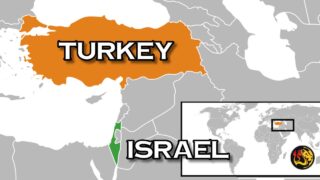
Cabinet vote marks historic acknowledgment of World War I massacre of Armenians as Turkey condemns decision
by Emmitt Barry, Worthy News Washington D.C. Bureau Chief
JERUSALEM (Worthy News) – The Israeli government has unanimously approved a proposal to recognize the mass killing of Armenian Christians by the Ottoman Empire during World War I as genocide, a historic step that acknowledges one of the darkest chapters of Christian suffering in the modern Middle East.
The resolution, initiated by Israeli Foreign Minister Gideon Sa’ar and backed by Prime Minister Benjamin Netanyahu’s Cabinet, now awaits approval by the Knesset before becoming formal Israeli state policy.
“It’s never too late to do the right thing,” Sa’ar wrote Sunday on X. “I thank Prime Minister Benjamin Netanyahu for the support and the government ministers for their unanimous support in approving the resolution proposal that I initiated for Israel’s recognition of the Armenian Genocide.”
Sa’ar said Israel had “fulfilled a moral obligation by recognizing the historical truth and rejecting attempts to deny it.”
The Armenian genocide refers to the systematic deportation, starvation, and mass killing of Armenians under the Ottoman Empire beginning in 1915. Historians estimate that as many as 1.5 million Armenians were killed or died during forced marches through the Syrian desert, with countless Armenian Christian communities uprooted, churches destroyed, families scattered, and an ancient people nearly erased from lands they had inhabited for centuries.
For Armenians worldwide, the wounds remain deeply personal. The genocide was not merely a wartime tragedy, but the destruction of a historic Christian civilization in Anatolia and the broader Ottoman world. Clergy, intellectuals, men, women, and children were targeted as Armenian villages and churches were emptied, leaving behind ruins, mass graves, and generations of survivors carrying the memory of what was lost.
Turkey has long rejected the term genocide, acknowledging that many Armenians died during World War I while insisting the deaths were the result of wartime chaos rather than a deliberate extermination campaign. Ankara has strongly opposed foreign governments that formally recognize the killings as genocide.
Israel’s move carries special weight because of the Jewish people’s own history of genocide and survival. For decades, Israeli governments avoided formal recognition of the Armenian genocide, largely because of strategic ties with Turkey. But as relations with Ankara have deteriorated under Turkish President Recep Tayyip Erdogan, Israel appears increasingly willing to speak openly about the historical record.
The Israeli Cabinet vote drew an immediate rebuke from Turkey. Turkish Vice President Cevdet Yilmaz accused Israel of trying to deflect criticism over its war in Gaza, calling the resolution “an attempt to cover up their own crimes,” according to Turkish media.
The vote comes as Erdogan continues to accuse Israel of genocide in Gaza during its war against Hamas. Israel has rejected those accusations, saying its military operation is aimed at dismantling Hamas following the October 7 attacks.
The Armenian National Committee-International cautiously welcomed the Israeli Cabinet decision but said the measure must be completed through parliamentary approval.
“If and when this initiative reaches its logical conclusion, and the Israeli parliament also approves the recognition of the Armenian Genocide as a matter of state policy, we will welcome that position,” the organization said.
If approved by the Knesset, Israel would join more than 30 nations, including the United States, that have formally recognized the Armenian genocide.
The decision also comes despite Armenia’s formal recognition of the State of Palestine in June 2024. Armenian officials have described the humanitarian situation in Gaza as “catastrophic” and have expressed support for a two-state solution to the Israeli-Palestinian conflict.
Still, Israel’s Cabinet approval signals that the memory of the Armenian Christian genocide is moving beyond diplomatic hesitation and into formal recognition. For Armenian Christians, it is an acknowledgment that their ancestors’ suffering must not be buried beneath political convenience or denied by the passage of time.
More than a century after Ottoman authorities began deporting and killing Armenian Christians, Israel’s vote marks a solemn reminder that the blood of persecuted believers still cries out from history — and that nations are judged not only by what they remember, but by what they refuse to forget.
Copyright 1999-2026 Worthy News. This article was originally published on Worthy News and was reproduced with permission.
Latest News from Worthy News

Political uncertainty remained Monday in Serbia after Serbian President Aleksandar Vucic announced he would resign within weeks and call early presidential and parliamentary elections following 18 months of student-led anti-government protests.

The Israeli government has unanimously approved a proposal to recognize the mass killing of Armenian Christians by the Ottoman Empire during World War I as genocide, a historic step that acknowledges one of the darkest chapters of Christian suffering in the modern Middle East.

The U.S. Supreme Court ruled Monday that states may count mail-in ballots received after Election Day, so long as they were sent on or before Election Day, handing a major defeat to the Republican National Committee and President Donald Trump’s administration in a closely watched election-law battle.

Residents of Venezuela’s capital, Caracas, awoke Monday to a fresh aftershock as rescuers raced to find survivors four days after twin earthquakes devastated parts of the country, killing nearly 1,500 people and injuring more than 3,000.

The Israel Defense Forces (IDF) destroyed a major underground Hezbollah complex in southwestern Lebanon on Sunday, uncovering hundreds of weapons, rocket launch silos, and infrastructure the military said was built with Iranian technology and expertise.
Turkish President Recep Tayyip Erdogan is pressing for Turkey’s full integration into Europe’s defense and security framework, arguing that Ankara’s military strength and NATO role make it indispensable to the continent’s future security.

Denmark’s immigration minister wants to ban the Islamic public call to prayer, saying “Islamization” has taken up “too much of the public space” and that parts of the Nordic nation resemble “a suburb of Islamabad.”