
by Emmitt Barry, Worthy News Washington D.C. Bureau Chief
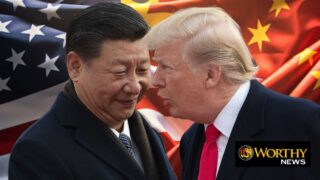
(Worthy News) – Chinese President Xi Jinping warned President Donald Trump on Thursday that any mishandling of Taiwan could push the United States and China toward “clashes and even conflicts,” injecting a sharp geopolitical warning into a summit both leaders had hoped would steady relations between the world’s two largest economies.
The warning came during a closed-door meeting in Beijing that lasted more than two hours, according to Chinese officials. Xi described Taiwan as “the most important issue in China-U.S. relations,” saying the broader relationship could remain stable only if Washington handled the matter properly. China claims Taiwan as its own territory, while Taiwan remains a self-governing democracy with its own elected government.
“If it is handled properly, the bilateral relationship will enjoy overall stability,” Xi said, according to China’s Foreign Ministry. “Otherwise, the two countries will have clashes and even conflicts, putting the entire relationship in great jeopardy.”
The White House readout of the meeting did not mention Xi’s Taiwan warning and instead characterized the talks as positive, focusing heavily on trade, energy, Iran, and economic cooperation. Trump also avoided answering reporters’ questions about Taiwan after the meeting, offering upbeat remarks about China and the summit atmosphere.
The summit, held at the Great Hall of the People, was framed by both governments as an opportunity to reduce tensions after years of tariffs, technology disputes, strategic rivalry, and growing military pressure around the Taiwan Strait. Trump had predicted the talks could become “the greatest summit ever,” and China rolled out an elaborate welcome ceremony, including a military band playing “The Star-Spangled Banner.”
While Taiwan loomed over the meeting, trade remained central. The two leaders discussed U.S. access to Chinese markets, Chinese purchases of American agricultural products, investment in U.S. industries, and broader efforts to stabilize economic ties. Xi, according to Chinese state media, said the economic relationship should be “mutually beneficial” and warned that “trade wars have no winner.”
Several major U.S. business leaders joined part of the summit, including Tesla CEO Elon Musk, Nvidia CEO Jensen Huang, and Apple CEO Tim Cook. Musk later described the meeting as “wonderful,” while Huang said the talks “went well.”
The summit also produced apparent alignment on Iran. According to the White House, Trump and Xi agreed that Iran must never obtain a nuclear weapon and that the Strait of Hormuz “must remain open” to preserve the free flow of global energy. Xi also voiced opposition to militarization of the strait and expressed interest in buying more American oil to reduce China’s reliance on energy moving through the Persian Gulf.
The Strait of Hormuz has become a major flashpoint during the Iran war, with Tehran accused of blocking Western-linked shipping and threatening global energy markets. China, as a major buyer of Iranian oil, is seen by Washington as one of the few powers with meaningful leverage over Tehran. Secretary of State Marco Rubio said before the summit that the United States would welcome a stronger Chinese role in pressing Iran to de-escalate.
Still, analysts cautioned that the summit did not appear to produce a major geopolitical breakthrough. Elaine Dezenski of the Foundation for Defense of Democracies said the talks may help extend a trade truce and reinforce shared opposition to Iran closing a critical energy corridor, but she warned that the structural challenges in U.S.-China relations “will not yield to a single summit.”
Trump invited Xi to visit the White House on Sept. 24, signaling that both leaders want to keep the diplomatic channel open despite deep divisions.
For Washington, the summit underscored the complexity of dealing with Beijing: China is an economic competitor, a strategic rival, a critical player in the Iran crisis, and the central threat facing Taiwan. For Beijing, the meeting offered a chance to court U.S. investment while pressing its long-term goal of weakening American support for Taiwan.
The public smiles were carefully choreographed. The private warning was unmistakable.
Copyright 1999-2026 Worthy News. This article was originally published on Worthy News and was reproduced with permission.
Latest News from Worthy News

The number of Americans filing for unemployment benefits remained relatively low in early August, offering another sign that widespread layoffs have yet to take hold even as hiring across the U.S. economy remains subdued.

The Israel Defense Forces (IDF) carried out a second preemptive airstrike in Gaza in two days Thursday, targeting a Hamas terror cell in Khan Yunis that Israeli military officials said was preparing an attack against Israeli forces.
The Trump administration has announced nearly $2 billion in health and humanitarian assistance for faith-based organizations, placing several major Christian ministries at the center of a reshaped U.S. foreign-aid strategy following sweeping cuts to USAID programs.

Hungarian Prime Minister Péter Magyar has cast doubt on a controversial Russian-led expansion of Hungary’s only nuclear power plant after record-low levels of the Danube River nearly forced its existing reactors into a complete shutdown.

The United States is preparing to send the USS George Washington aircraft carrier to the Middle East, replacing the USS Abraham Lincoln after an exceptionally long deployment supporting American military operations against Iran, according to an exclusive report by The Wall Street Journal.

Saudi Arabia, Turkey and Pakistan are moving to deepen military cooperation under a new mutual-defense pact that Israeli analysts say could reshape the Middle East’s security architecture while reducing dependence on the United States and bypassing Israel.

Americans added another $21 billion in credit card debt during the second quarter of 2026, pushing outstanding balances to roughly $1.26 trillion and bringing consumer borrowing close to its record high.