
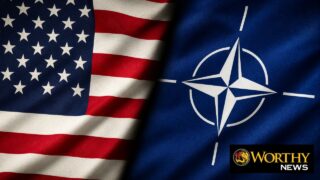
by Stefan J. Bos, Worthy News Europe Bureau Chief reporting from Budapest, Hungary
BRUSSELS/BUDAPEST (Worthy News) – There is mounting concern about the future of the NATO military alliance after U.S. President Donald J. Trump announced plans to withdraw thousands of troops from Germany, as transatlantic tensions deepen over the Middle East war.
NATO said Saturday that it was working with Washington to understand plans to pull about 5,000 troops from Germany, a move expected to impact all its 32 member states.
“The greatest threat to the transatlantic community are not its external enemies, but the ongoing disintegration of our alliance,” warned Polish Prime Minister Donald Tusk on Saturday. “We must all do what it takes to reverse this disastrous trend,” he added.
Tusk spoke at a time when war rages in Europe following Russia’s full-scale invasion of Ukraine in February 2022.
ALLIANCE STRAINS GROW
There is rising unease within NATO that Washington’s latest move could weaken collective defense at a critical moment.
Two senior U.S. lawmakers from President Trump’s Republican Party said they were “very concerned” about the decision to withdraw a U.S. brigade from Germany.
“Rather than withdrawing forces from the continent altogether, it is in the U.S. interest to maintain a strong deterrent in Europe,” said Senator Roger Wicker and Representative Mike Rogers, who chair the Senate and House Armed Services Committees respectively.
PENTAGON DEFENDS MOVE
The Pentagon said the troop reduction of roughly 5,000 personnel would be completed within six to twelve months.
“This decision follows a thorough review of the Department’s force posture in Europe and is in recognition of theater requirements and conditions on the ground,” Pentagon spokesman Sean Parnell said in a statement.
There were 36,436 active-duty U.S. troops stationed in Germany as of December 31, 2025, compared with 12,662 in Italy and 3,814 in Spain, officials said.
TRANSATLANTIC RIFT DEEPENS
The announcement follows a public spat between President Trump and German Chancellor Friedrich Merz over the Middle East conflict.
Merz said Iran was “humiliating” Washington at the negotiating table, prompting Trump to respond that the German leader “doesn’t know what he’s talking about.”
The dispute escalated as Trump announced plans to raise tariffs on European Union cars and trucks to 25 percent, accusing the bloc of failing to comply with a previous trade agreement.
EUROPE URGED TO STEP UP
German Defense Minister Boris Pistorius said the troop reduction “was to be expected,” signaling Berlin had been preparing for such a scenario.
NATO spokeswoman Allison Hart said the development underscored “the need for Europe to continue to invest more in defense and take on a greater share of the responsibility for our shared security.”
President Trump has long argued that European allies should contribute more to their own defense rather than relying heavily on U.S. military support.
BROADER SECURITY CONCERNS
President Trump also suggested he could pull troops from Italy and Spain, criticizing their stance on the Middle East war, after both countries refused to back U.S. operations against Iran and restricted the use of bases and airspace in a rare public split with Washington.
European officials, however, stressed that American military deployments on the continent remain in Washington’s strategic interest.
German Foreign Minister Johann Wadephul said Berlin was “prepared” for a reduction but insisted major U.S. bases such as Ramstein Air Base were “not up for discussion” due to their “irreplaceable function.”
UKRAINE WAR BACKDROP
The developments come as European governments remain on high alert following Russia’s invasion of Ukraine, with continued drone incursions and security threats keeping defense at the top of the agenda.
Berlin has pledged increased military spending and reaffirmed support for Kyiv, while European Union officials reiterated that the United States remains a “vital partner” in ensuring the continent’s security.
Yet with tensions rising over both the Middle East and transatlantic trade, officials warn that unity within NATO may face one of its most serious tests in years.
Copyright 1999-2026 Worthy News. This article was originally published on Worthy News and was reproduced with permission.
Latest News from Worthy News

President Donald Trump on Monday ordered a sweeping overhaul of federal childhood vaccine recommendations, reducing the number of diseases for which vaccines are universally recommended while directing health officials to give parents greater control over when and how their children receive immunizations.
President Donald Trump scored a significant legal victory Monday in his $10 billion defamation lawsuit against the BBC after a federal judge allowed him to amend his complaint and effectively wiped out the British broadcaster’s pending attempt to have the case dismissed.
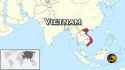
A Vietnamese court has sentenced Montagnard Protestant pastor Y Nuen Ayun to seven and a half years in prison on charges of “undermining the national unity policy,” trial observers told Worthy News on Monday.

Russian authorities say at least 13 people were killed and 39 others wounded Monday in Ukrainian drone attacks on an industrial city about 900 kilometers, or 600 miles, east of Moscow. The latest strikes signaled a further escalation of Ukraine’s campaign of air attacks deep inside Russia.

A powerful magnitude 7.4 earthquake struck western Colombia Monday, collapsing buildings, trapping residents beneath rubble, disrupting airports and sending tremors across much of the country and into neighboring Venezuela.

Archaeologists in modern-day Turkey have uncovered remains of an ancient church believed to be connected to the historic site where the First Council of Nicaea was held in A.D. 325, drawing fresh attention to one of the most consequential turning points in the history of Christianity.
President Donald Trump’s sweeping “Make D.C. Safe Again” law-enforcement campaign is approaching its first anniversary with more than 16,000 arrests, as the administration says its unprecedented federal-local partnership is changing the security landscape of the nation’s capital.