
by Emmitt Barry, with reporting from Worthy News Jerusalem Bureau Staff
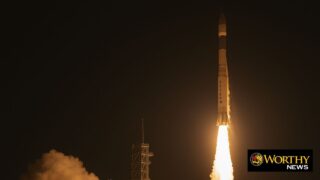
JERUSALEM (Worthy News) – Israel successfully launched the Ofek 19 reconnaissance satellite into orbit Tuesday night, marking a significant leap forward in the nation’s military space program and strengthening its intelligence and surveillance capabilities across the Middle East.
The launch took place at 10:30 p.m. from the Palmachim Airbase in central Israel using a three-stage Shavit launcher. According to the Defense Ministry, the satellite achieved orbit, began transmitting data back to Earth, and completed its first series of tests, paving the way for full operational service in the coming days.
The Ofek 19 project is a joint effort of the Israeli Ministry of Defense’s Directorate of Defense Research and Development, the Israel Defense Forces (IDF), and Israel Aerospace Industries (IAI). Once final testing is completed, control will be handed over to Unit 9900, the IDF’s geospatial intelligence division.
Advanced Capabilities
The Defense Ministry described Ofek 19 as a radar observation satellite equipped with synthetic aperture radar (SAR), capable of delivering high-resolution imaging and reconnaissance in all weather conditions, day or night. It will operate at an altitude of about 500 kilometers (310 miles), circling the Earth every 90 minutes.
IAI CEO Boaz Levy emphasized the satellite’s strategic significance: “Ofek 19 adds new capabilities—an eye in the sky—expanding Israel’s control over the Middle East from space. Combined with other satellite and missile-defense advancements, space is rapidly becoming a critical dimension in warfare.”
National Pride and Security Edge
President Isaac Herzog, who attended the launch, called the event “extraordinary and inspiring,” adding:
“This achievement proves that Israel is not only a Startup Nation but also a Space Nation.”
Defense Minister Israel Katz hailed the launch as “a moment of tremendous national pride,” highlighting that the satellite “embodies Israeli innovation and significantly strengthens our national security by maintaining Israel’s technological superiority.”
Frontline in Regional Conflicts
Defense officials noted that Israel’s satellite program has already played a vital role in recent conflicts with Hamas and Hezbollah, particularly during Operation Iron Swords and Operation Rising Lion. Space-based intelligence provided real-time reconnaissance, target generation, and post-strike assessment—functions described as indispensable in modern warfare.
“Space gives the IDF access to the entire Middle East,” a senior defense official said. “What once was a fantasy is now becoming a reality: continuous satellite coverage that safeguards Israel against regional threats.”
Israel Among Global Space Powers
Israel first joined the elite group of spacefaring nations in 1988 with the launch of Ofek 1. Today, it is one of only 13 countries with independent satellite launch capabilities, standing alongside the United States, Russia, China, India, and a handful of others.
With global investment in military space programs surging—over 50 nations now maintain defense-related space budgets—Israel continues to cement its reputation as a leader in advanced defense technologies.
For Israel, the successful launch of Ofek 19 represents both continuity and progress: continuity in a decades-long satellite program and progress toward maintaining strategic superiority in an increasingly contested space domain.
Copyright 1999-2026 Worthy News. This article was originally published on Worthy News and was reproduced with permission.
Latest News from Worthy News

The number of Americans filing for unemployment benefits remained relatively low in early August, offering another sign that widespread layoffs have yet to take hold even as hiring across the U.S. economy remains subdued.

The Israel Defense Forces (IDF) carried out a second preemptive airstrike in Gaza in two days Thursday, targeting a Hamas terror cell in Khan Yunis that Israeli military officials said was preparing an attack against Israeli forces.

The Trump administration has announced nearly $2 billion in health and humanitarian assistance for faith-based organizations, placing several major Christian ministries at the center of a reshaped U.S. foreign-aid strategy following sweeping cuts to USAID programs.

Hungarian Prime Minister Péter Magyar has cast doubt on a controversial Russian-led expansion of Hungary’s only nuclear power plant after record-low levels of the Danube River nearly forced its existing reactors into a complete shutdown.

The United States is preparing to send the USS George Washington aircraft carrier to the Middle East, replacing the USS Abraham Lincoln after an exceptionally long deployment supporting American military operations against Iran, according to an exclusive report by The Wall Street Journal.

Saudi Arabia, Turkey and Pakistan are moving to deepen military cooperation under a new mutual-defense pact that Israeli analysts say could reshape the Middle East’s security architecture while reducing dependence on the United States and bypassing Israel.

Americans added another $21 billion in credit card debt during the second quarter of 2026, pushing outstanding balances to roughly $1.26 trillion and bringing consumer borrowing close to its record high.