
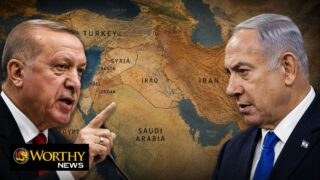
by Emmitt Barry, Worthy News Washington D.C. Bureau Chief
(Worthy News) – Turkish President Recep Tayyip Erdogan warned Wednesday that Israel’s military operations in Syria and Lebanon have reached the point of threatening Turkey itself, escalating a bitter war of words with Israeli Prime Minister Benjamin Netanyahu as tensions widen across the Middle East.
Speaking to lawmakers from his ruling AK Party in parliament, Erdogan accused Netanyahu and what he called his “network of murder” of expanding the conflict beyond Israel’s immediate borders. He said Ankara views the security of Syria and Lebanon as directly tied to Turkey’s own national security.
“The attacks by Netanyahu and his network of murder on Lebanon and Syria have brought the issue to a point where it also threatens Turkey,” Erdogan said, according to Reuters. He further accused Israel of destabilizing the region and said its “aggression” posed a threat not only to Turkey, but to the world.
Turkey, a NATO member and neighbor of Iran, has become one of Israel’s fiercest critics during the widening regional conflict. Ankara has halted all trade with Israel, accused Jerusalem of being the chief obstacle to regional peace, and called for international legal measures against the Jewish state. Erdogan has also blamed Israeli “provocations” for helping trigger the broader U.S.-Iran war.
Erdogan widened his criticism beyond Syria and Lebanon, accusing Israel of pursuing a “sneaky effort” to destabilize African countries and the Mediterranean by stirring division on Cyprus, the ethnically divided island where Turkey maintains deep political and military interests.
“Nobody should chase adventures,” Erdogan warned. “I want everyone to know that if the rights of Turkey and Turkish Cypriots are violated in the Eastern Mediterranean, our response will be very clear and very strong.”
His remarks come amid a broader Turkish push to assert influence across former Ottoman spheres, including Syria, the Eastern Mediterranean, North Africa, and the Muslim world. Analysts have often described Erdogan’s foreign policy posture as “neo-Ottoman,” marked by a blend of Turkish nationalism, political Islam, and regional power projection. One 2025 analysis described Erdogan’s Turkey as portraying itself as both “heir to the Ottoman Empire” and a champion of Sunni Muslims, particularly in the Middle East, Eastern Mediterranean, and North Africa.
Netanyahu responded sharply on X, calling Erdogan “the antisemitic dictator” and accusing him of backing Hamas, oppressing his own people, imprisoning political rivals, and committing genocide against the Kurds.
“The State of Israel and the IDF, the most moral military in the world, will continue to act decisively against Iran and its proxies, which threaten the Middle East and the entire world,” Netanyahu said.
Israel maintains that its operations in Lebanon and Syria are aimed at Iranian-backed terror networks, including Hezbollah, and are necessary to prevent Tehran and its proxies from building forward bases along Israel’s borders. Israeli officials have repeatedly argued that Iran’s regional network—stretching through Lebanon, Syria, Iraq, Yemen, and Gaza—poses an existential threat to the Jewish state.
Prophetic Watch: Turkey, Gog and Magog
For many Bible-believing Christians, Turkey’s growing hostility toward Israel carries prophetic significance, especially in light of Ezekiel 38–39, which describes a future coalition coming against Israel in the latter days.
While Scripture does not name “Turkey” directly in modern political terms, several peoples listed in Ezekiel’s Gog-Magog prophecy—often identified by Bible scholars with regions in or near modern Turkey, the Caucasus, Iran, and the broader Middle East—have long drawn attention from prophecy watchers. Erdogan’s increasingly confrontational posture toward Israel, his alignment with anti-Israel rhetoric, and his ambitions to restore Turkish influence across former Ottoman lands may therefore be seen as a possible prophetic foreshadowing.
This does not mean current events can be declared the fulfillment of Ezekiel 38–39. However, it does show how the geopolitical pieces of the region continue to move in ways that align with the biblical expectation that Israel will one day face a hostile northern-led coalition. For believers watching the times, Erdogan’s warning is not merely political noise—it is another reminder that the nations surrounding Israel remain central to the prophetic storyline.
Copyright 1999-2026 Worthy News. This article was originally published on Worthy News and was reproduced with permission.
Latest News from Worthy News

The number of Americans filing for unemployment benefits remained relatively low in early August, offering another sign that widespread layoffs have yet to take hold even as hiring across the U.S. economy remains subdued.

The Israel Defense Forces (IDF) carried out a second preemptive airstrike in Gaza in two days Thursday, targeting a Hamas terror cell in Khan Yunis that Israeli military officials said was preparing an attack against Israeli forces.

The Trump administration has announced nearly $2 billion in health and humanitarian assistance for faith-based organizations, placing several major Christian ministries at the center of a reshaped U.S. foreign-aid strategy following sweeping cuts to USAID programs.

Hungarian Prime Minister Péter Magyar has cast doubt on a controversial Russian-led expansion of Hungary’s only nuclear power plant after record-low levels of the Danube River nearly forced its existing reactors into a complete shutdown.

The United States is preparing to send the USS George Washington aircraft carrier to the Middle East, replacing the USS Abraham Lincoln after an exceptionally long deployment supporting American military operations against Iran, according to an exclusive report by The Wall Street Journal.

Saudi Arabia, Turkey and Pakistan are moving to deepen military cooperation under a new mutual-defense pact that Israeli analysts say could reshape the Middle East’s security architecture while reducing dependence on the United States and bypassing Israel.

Americans added another $21 billion in credit card debt during the second quarter of 2026, pushing outstanding balances to roughly $1.26 trillion and bringing consumer borrowing close to its record high.