
By Stefan J. Bos, Chief International Correspondent Worthy News
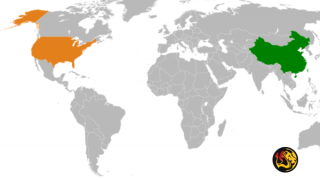
WASHINGTON/TAIPEI/BEIJING (Worthy News) – The United States and China came close to a military confrontation Thursday as the U.S. Navy’s 7th Fleet received a Chinese warning when one of its warships passed through the Taiwan Strait, military officials said.
The 7th Fleet confirmed the incident happened when the “Arleigh Burke-class guided-missile destroyer USS Ralph Johnson” was in the narrow waterway separating China and Taiwan by about 128 kilometers (80 miles).
China has been regularly conducting exercises there while increasing rhetoric about seizing Taiwan, the democratically ruled island Beijing views as its territory.
China’s military said it sent naval and air forces to monitor and warn the U.S. ship and would “deal with it in accordance with the law and regulations.”
“Troops in the theatre remain on high alert at all times and will resolutely safeguard national sovereignty and security as well as regional peace and stability,” the Chinese People’s Liberation Army said in published remarks.
The 7th Fleet defended its actions, saying, “The ship transited through a corridor in the Strait that is beyond the territorial sea of any coastal state.”
It added, “No member of the international community should be intimidated or coerced into giving up their rights and freedoms. The United States military flies, sails, and operates anywhere international law allows.”
Yet boldened by its growing military, Communist-run China has made clear that it is prepared to defend its interests, including taking over Taiwan by force if necessary, despite U.S. military support for the island.
In May, the U.S. State Department called for de-escalation after what it described as military provocations by the Chinese military, which conducted two days of attack drills off the coast of Taiwan.
The United States and Canada sent other vessels through the strait earlier this year. Sources say Germany is set to send two warships next month.
The United States, France, Germany, Indonesia, Italy, Japan, Malaysia, Singapore, and the Philippines have all conducted military exercises in the South China Sea, saying it was focused on deterrence.
The growing tensions come at a difficult moment as at least a third of the world’s trade passes through the South China Sea. The Taiwan Strait is a key route, handling 44 percent of the world’s container fleet and more than 80 percent of the largest ships, according to official data.
Taiwan also produces about 90 percent of the world’s most advanced microchips at a time of rapidly spreading artificial intelligence.
Copyright 1999-2026 Worthy News. This article was originally published on Worthy News and was reproduced with permission.
Latest News from Worthy News

President Donald Trump signed the temporary peace deal with Iran ahead of schedule Wednesday at the Palace of Versailles in France, kicking off negotiations over a final nuclear deal.
Iran’s Supreme Leader Mojtaba Khamenei’s statement following the signing of a memorandum of understanding with the United States is being viewed by analysts not as an embrace of peace, but as a carefully crafted declaration that preserves Tehran’s revolutionary posture while allowing the regime to regroup.

The United States imposed new sanctions Thursday on individuals and entities linked to Hezbollah, accusing them of using political and financial influence to obstruct Lebanon’s peace process and delay the Iran-backed group’s disarmament.

Ukraine launched one of its largest drone attacks on Moscow since the war began, hitting a key oil refinery and other targets around the Russian capital, leaving at least one person dead and numerous others injured, Russian officials said.

Russian President Vladimir Putin hosted Southeast Asian leaders in Kazan this week as Moscow moved to deepen ties with the Association of Southeast Asian Nations and promote its vision of a “multipolar world order” aimed at countering U.S. global dominance.

Israeli Prime Minister Benjamin Netanyahu said Thursday that Israeli troops will not withdraw from southern Lebanon and will maintain a security zone there for as long as Israel’s defense needs require, placing Jerusalem at odds with both Tehran and the terms of a U.S.-Iran memorandum that calls for an end to hostilities in Lebanon.

U.S. Defense Secretary Pete Hegseth told NATO leaders Thursday that the Pentagon is launching a six-month review of U.S. force posture and basing in Europe, signaling a major push by the Trump administration to ensure European allies assume primary responsibility for defending the continent.