
by Emmitt Barry, Worthy News Washington D.C. Bureau Chief
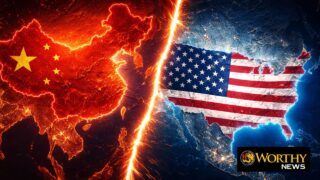
(Worthy News) – U.S. President Donald Trump warned that China could face steep economic consequences if it is found to be supplying weapons to Iran, escalating tensions as conflict in the Middle East continues to reverberate globally.
Speaking in an April 12 interview with Fox News, Trump said reports had surfaced suggesting Beijing may be providing Iran with shoulder-fired anti-aircraft missiles, also known as man-portable air defense systems (MANPADS). While expressing skepticism about the claims, Trump made clear the U.S. response would be swift if verified.
“I doubt they would do that,” Trump said. “But if we catch them doing that, they get a 50 percent tariff, which is staggering.”
The warning builds on earlier statements from the president that any nation found arming Iran during the ongoing conflict would face immediate trade penalties.
Tensions Rise After Failed Talks
The remarks come after U.S.-Iran peace negotiations collapsed on April 12, with Vice President JD Vance stating that Tehran refused to abandon its nuclear ambitions. The breakdown in talks followed a temporary ceasefire and has raised fears of further escalation.
In response, Trump ordered a U.S. naval blockade targeting Iranian ports, with enforcement beginning April 13, according to U.S. Central Command. The blockade aims to prevent vessels from entering Iranian ports while maintaining freedom of navigation for ships traveling to other destinations in the region.
CENTCOM also confirmed that U.S. forces have initiated mine-clearing operations in the Strait of Hormuz, a critical global shipping route responsible for roughly one-fifth of the world’s oil supply. The effort is intended to ensure safe passage for international trade amid rising instability.
Uncertainty Over China’s Role
Reports from U.S. intelligence and media outlets have fueled speculation that China may be preparing to supply Iran with advanced air defense systems. However, no official confirmation has been provided, and Trump himself questioned the reliability of such reports.
China has historically maintained strong economic ties with Iran, particularly in energy. Analysts note that Beijing relies heavily on seaborne oil imports and has been a major purchaser of Iranian crude, accounting for a significant portion of Tehran’s sanctioned exports.
Experts say that if China were to provide direct military support, it would represent a significant shift in its approach and could further destabilize the region.
Economic and Strategic Stakes
The potential for tariffs underscores the broader economic dimension of the conflict. Following a recent U.S. Supreme Court ruling limiting the president’s emergency tariff powers, the Trump administration has launched new trade investigations under Section 301 of the Trade Act of 1974, targeting alleged unfair practices by China and other nations.
U.S. Trade Representative Jamieson Greer said the probes will assess whether foreign governments are doing enough to prevent forced labor imports and how such practices impact American workers and businesses.
Meanwhile, Trump is expected to meet Chinese leader Xi Jinping in Beijing on May 14, a high-stakes summit that could shape both trade relations and geopolitical strategy moving forward.
As tensions mount, the intersection of military conflict and global commerce is becoming increasingly evident, with the Strait of Hormuz and U.S.-China relations emerging as central pressure points in an already volatile situation.
Copyright 1999-2026 Worthy News. This article was originally published on Worthy News and was reproduced with permission.
Latest News from Worthy News

Antisemitic violence worldwide reached its deadliest level in more than three decades during 2025, according to a new report documenting a sharp escalation in threats and attacks against Jewish communities.

Israeli Prime Minister Benjamin Netanyahu said Israeli special forces could be called upon if he were threatened with arrest while traveling abroad under a warrant issued by the International Criminal Court.

Ukraine said Wednesday it struck two of Russia’s largest oil refineries in overnight long-range drone attacks, intensifying pressure on Moscow as President Volodymyr Zelenskyy met U.S. President Donald J. Trump in Washington.
Three Christian men who were detained in Pakistan for allegedly “desecrating” the Quran, viewed by Muslims as holy, have been released after police and authorities concluded the allegation “stemmed from a personal dispute rather than an act of blasphemy,” Christian advocates told Worthy News Wednesday.
Japan’s prime minister warned Wednesday that “every second counts” after a 6.8-magnitude earthquake struck the country’s southern Kumamoto Prefecture, killing more than a dozen people.

Israeli Defense Minister Israel Katz has ordered the military to expand counterterrorism operations across Judea and Samaria, warning that Palestinian terrorist organizations are attempting to rebuild their strength after suffering major setbacks during previous Israeli campaigns.

The United States is preparing to assume responsibility for financing and operating concrete plants used to seal Hamas terror tunnels in the Gaza Strip, according to an Israel Hayom report published Wednesday.