
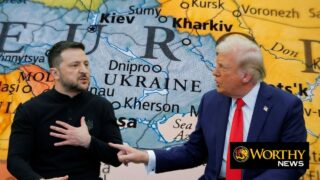
by Stefan J. Bos, Worthy News Europe Bureau Chief
KYIV/WASHINGTON, D.C. (Worthy News) – In a major setback for Ukraine facing relentless Russian attacks, U.S. President Donald J. Trump said a ceasefire was not necessary to negotiate an end to the Ukraine-Russia war.
Trump spoke at the White House when asked if there would still be “severe consequences” for Russia if a ceasefire wasn’t agreed, as he had previously said.
“I don’t think you need a ceasefire,” he said, with Ukrainian President Volodymyr Zelenskyy visibly upset while sitting next to him. A truce is “good to have,” but he added that he could understand why one country might not want one.
“We can work a peace deal while they’re fighting. They have to fight. I wish they could stop, I’d like them to stop, but strategically that could be a disadvantage for one side or the other,” he explained.
Earlier, Trump was asked if he would offer Ukraine NATO-style Article 5 security guarantees, which state that an attack on one NATO member is an attack on all.
Trump said this has not yet been discussed but pledged to Kyiv: “We will give them very good protection, very good security. That’s part of it.”
SHIFT POSITION RAISES CONCERNS
Trump’s remarks marked a departure from his earlier stance that a ceasefire was essential before peace talks. Analysts noted the shift mirrors some of Moscow’s preferences, fueling concern among Western allies.
However, Zelenskyy reiterated that Ukraine would not accept any peace agreement requiring it to give up territory, insisting sovereignty and territorial integrity remain non-negotiable.
European leaders, including officials from Britain, France, and Germany, stressed that Ukraine must be provided with credible and enforceable security assurances before any peace deal is finalized. Some floated the idea of a “coalition of the willing” to back Ukraine if NATO cannot formally extend Article 5 protection.
Yet despite these differences, both Trump and Zelenskyy expressed hope that Russian President Vladimir Putin could eventually join in trilateral discussions.
The talks with reporters came as Zelenskyy, along with European and NATO military leaders, sought assurances that Washington would not make a separate deal with Moscow that could sideline Ukraine and its allies.
STRIKES CONTINUE TO KILL
Even as talks unfolded, Russian strikes continued across Ukraine.
Local authorities reported fresh drone and missile attacks on Kharkiv and Zaporizhzhia, killing and injuring dozens, including children.
Back at the White House, the atmosphere was different from February, when Trump berated Zelenskyy in an unprecedented quarrel broadcast worldwide.
A reporter who had previously criticized Zelenskyy for not dressing formally enough said this time that the Ukrainian president looked “fabulous” in his suit — a sentiment Trump said he shared. The reporter apologized to Zelenskyy.
The Ukrainian president, a former comedian, quickly seized the moment to quip that while he changed his clothes, the journalist was wearing the same suit as during their last encounter: “I changed, you did not.”
Copyright 1999-2026 Worthy News. This article was originally published on Worthy News and was reproduced with permission.
Latest News from Worthy News

A federal appeals court on Tuesday temporarily allowed the Trump administration to continue collecting its 10% global tariff, pausing a lower-court ruling that found the import duties unlawful for three plaintiffs who had won relief last week. The U.S. Court of Appeals for the Federal Circuit issued a short-term administrative stay while it considers whether to keep the tariffs in place during the government’s appeal.

Saudi Arabia launched covert airstrikes inside Iran during the recent Middle East war, according to a Reuters exclusive citing two Western officials and two Iranian officials — a move that, if confirmed, would mark the first known Saudi military action carried out directly on Iranian soil. The reported strikes came in late March after the kingdom suffered Iranian attacks, including missile and drone strikes that exposed vulnerabilities in the U.S.-backed security umbrella protecting Gulf Arab states.

Russian President Vladimir Putin announced Tuesday that Russia had successfully test-fired its new Sarmat intercontinental ballistic missile — nicknamed “Satan II” by NATO — declaring it the most powerful missile in the world and saying it would enter combat service by the end of 2026.

Hungary’s new government signaled Monday it will continue buying Russian energy despite European Union plans to phase out imports of Russian oil and natural gas, raising the prospect of an early confrontation with Brussels.

More than 100 new evangelical churches have reportedly opened and thousands of people have been baptized in Ukraine since Russia launched its full-scale invasion of the country in February 2022, church leaders say.

Hezbollah Secretary-General Naim Qassem said an agreement between Iran and the United States may be the best path to ending Israeli military operations in Lebanon, while defiantly rejecting any outside demand that the Iranian-backed terrorist group disarm.

U.S. federal prosecutors announced criminal charges Tuesday against the operator of the cargo ship that struck and destroyed Baltimore’s Francis Scott Key Bridge in 2024, killing six construction workers.