
by Emmitt Barry, Worthy News Washington D.C. Bureau Chief
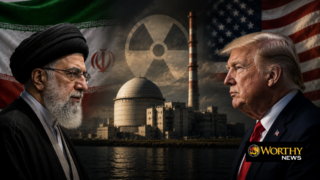
(Worthy News) – Iran’s Supreme Leader Mojtaba Khamenei’s statement following the signing of a memorandum of understanding with the United States is being viewed by analysts not as an embrace of peace, but as a carefully crafted declaration that preserves Tehran’s revolutionary posture while allowing the regime to regroup.
Khamenei said Iranian officials had worked “out of compassion and goodwill” to reach the agreement, while accusing President Donald Trump of acting “out of desperation” and using “all kinds of leverage” to secure it. He said he personally held a “different view” of the MOU but approved it after Iranian President Masoud Pezeshkian, acting as head of the Supreme National Security Council, pledged to safeguard Iran’s national rights and the interests of the so-called “Resistance Front.”
That phrase is central to understanding Tehran’s message.
For Iran, the “Resistance Front” refers to the network of armed and political proxies it has cultivated across the Middle East, including Hezbollah in Lebanon, Hamas and Palestinian Islamic Jihad, the Houthis in Yemen, and Iranian-backed militias in Iraq and Syria. These forces have long served as Tehran’s forward-deployed pressure campaign against Israel, the United States, and Sunni Arab rivals.
Counterterrorism expert Dr. Omar Mohammed told Fox News Digital that Khamenei was not endorsing reconciliation with Washington, but authorizing what amounts to a tactical pause.
“Khamenei is not endorsing peace with America,” Mohammed said. “He is authorizing a tactical pause while protecting the Resistance Front, shifting responsibility to the elected administration, and preserving the ideological framework of permanent confrontation.”
He added that the reference to the Resistance Front was the clearest signal in the statement.
“This is not the language of reconciliation,” Mohammed said. “It is the language of regime insurance.”
Khamenei’s statement also stressed that future negotiations with Washington do not mean Iran accepts the position of the United States. Analysts say that line was directed as much at Iran’s own hardline base, the Islamic Revolutionary Guard Corps, and regional proxies as it was at the White House.
The message appeared designed to reassure the regime’s most powerful constituencies that diplomacy does not equal normalization, and that any pause in hostilities is conditional, tactical, and reversible.
Mohammed warned that the document should be read with caution, saying it did not resemble a personal reflection from a leader but rather a curated regime statement intended for multiple audiences at once: the IRGC, Iran’s proxy network, the Iranian public, the Pezeshkian administration, and Washington.
“If Mojtaba personally directed this message, it suggests he has access to the full state file and is managing the presidency, the security council, the IRGC, and the proxy network,” Mohammed said. “If he did not, then the security apparatus may be speaking through his name to project continuity.”
The religious ending of the statement, Mohammed added, also matters. In his view, it reflected revolutionary language intended to present a diplomatic pause as another stage in a continuing struggle.
That warning touches the deeper reality behind the MOU: Iran’s conflict with Israel and the West is not merely geopolitical. It is rooted in the ideological and theological foundations of the Islamic Republic.
Iran’s ruling system is built on Twelver Shia Islam, which holds that the twelfth imam, known as the Mahdi or Hidden Imam, will return at the end of days to establish justice and divine rule. While many Shia believers understand this doctrine in spiritual and devotional terms, Iran’s revolutionary leadership has historically fused religious expectation with state power, anti-Western ideology, and militant regional strategy.
Since the 1979 Islamic Revolution, Tehran has cast itself not simply as a nation-state defending its borders, but as the vanguard of an Islamic revolutionary project. Its hostility toward Israel and the United States has therefore been presented not only as a matter of policy, but as part of a larger religious and ideological confrontation.
That is why chants of “Death to America” and “Death to Israel” have never been treated by Israeli officials or many regional observers as empty slogans. They are viewed as windows into a regime that has built much of its legitimacy around resistance to the West, the destruction of Israel, and the export of revolutionary Islamist power through armed proxies.
The MOU may lower the temperature temporarily. It may pause direct hostilities, reopen diplomatic channels, and give Washington and Tehran a framework for further talks. But it does not erase the ideological engine of the Islamic Republic, nor does it dismantle the IRGC, disarm Hezbollah, neutralize the Houthis, or sever Iran’s regional proxy network.
Most importantly, no regime change has taken place in Tehran.
The same revolutionary system remains in power. The same clerical-security establishment remains intact. The same proxy architecture remains in place. The same theological and ideological hostility toward Israel and the United States remains embedded in the regime’s political culture.
For that reason, many analysts believe the war has not ended. It has merely entered another phase.
Washington may call the MOU a diplomatic breakthrough. Tehran may present it as a conditional victory. But Khamenei’s own words suggest something far more sobering: Iran is not surrendering its long war against the West and Israel. It is pausing, preserving its networks, and waiting to see whether the next stage can be fought from a stronger position.
Copyright 1999-2026 Worthy News. This article was originally published on Worthy News and was reproduced with permission.
Latest News from Worthy News

Hungary was racing Saturday to avert the first complete shutdown in the 44-year history of its only nuclear power plant after record-low Danube water levels threatened the country’s electricity supply, prompting sweeping emergency measures amid an ongoing heatwave.

Motivational speaker Tony Robbins told Health and Human Services Secretary Robert F. Kennedy Jr. that advances in nanotechnology could make it possible to connect the human brain directly to artificial intelligence as early as 2031 or 2032, opening the door to widespread human-AI integration within the next decade.

The Democratic National Committee is facing a deepening financial and leadership crisis ahead of the November midterm elections, prompting prominent voices on the Left to warn that the party’s national organization is becoming dangerously unprepared for the political battle ahead.
President Donald Trump said Friday that Israel was “very happy” with a newly announced agreement aimed at disarming Hamas, even as Prime Minister Benjamin Netanyahu remained publicly silent and senior Israeli officials indicated that Jerusalem had not accepted the proposal in its current form.

Spain and neighboring Morocco reinforced security around the Spanish enclave of Ceuta after tens of thousands of migrants entered the territory illegally in recent days, while at least 34 people died attempting the dangerous crossing, authorities said Friday.

The Republican-led Senate narrowly rejected another attempt Thursday to force an end to unauthorized U.S. military operations against Iran, preserving President Donald Trump’s ability to continue the campaign without a new authorization from Congress.

Hungary’s only nuclear power plant could be forced to shut down within days after record-low water levels on the Danube River sharply reduced its cooling capacity, raising fresh concerns over Europe’s energy security amid an intense heatwave.