
By Stefan J. Bos, Chief International Correspondent Worthy News
ROME/BUDAPEST (Worthy News) – Italian researchers have reopened the 600-year-old debate over the Shroud of Turin, the linen cloth that some believe was used to wrap the body of Jesus after his crucifixion.
Using a technique called Wide-Angle X-ray scattering, scientists from Italy’s Institute of Crystallography claim to have discovered new evidence that the shroud dates back to Jesus’ life.
In a study published in the journal Heritage, the authors shared dating work on a sample from the Shroud and concluded that it may be a 2,000-year-old relic.
While the latest study does not reveal whether or not the artifact was indeed Jesus’ burial shroud, the authors did find that its age is roughly consistent with his time.
The findings challenge previous research backing a medieval origin of the Shroud, one of the most studied archaeological objects in the world.
The Shroud of Turin, also known as the Holy Shroud, is 4.3 meters (14 feet 3 inches) long and 1.1 meters (3 feet 7 inches) wide.
BROWN IMAGES
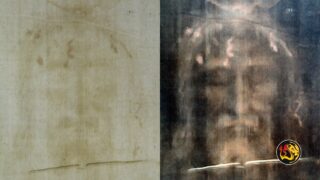
It has long been the subject of intense scrutiny: features of a faint image of a man that some believe is the body of Jesus miraculously imprinted onto the cloth.
The shroud portrays two faint, brown images of a man 5 feet 7 inches tall, seen from the front and the back.
Believers in the shroud claim that “these images are evidence” that this is the very piece of cloth used to wrap Jesus’ body after his death.
Other Bible-believing Christians would argue that the shroud should not become the basis of faith in Jesus Christ, who told the disciple Thomas in John 20:29, “Because you have seen me, you have believed; blessed are those who have not seen and yet have believed.”
According to historical records, the shroud first appeared in 1354 in France.
After initially denouncing it as “a fake,” the Catholic Church embraced the shroud as genuine.
The first evidence of the shroud’s existence emerged in 1354 when it appeared in the possession of a knight named Geoffroi de Charnay.
FAKE SHROUD?
At the time, the local bishop reportedly denounced the shroud as “a fake” and claimed a local artist had painted it.
Yet, by the 1400s, the shroud’s authenticity was taken for granted, and it became an object of worship.
In December 1532, when its chapel burned down, the shroud was extensively damaged by fire and water, and the material had to be repaired with patches.
However, centuries later, the mystery surrounding the Shroud of Turin continues to attract worldwide attention.
Copyright 1999-2026 Worthy News. This article was originally published on Worthy News and was reproduced with permission.
Latest News from Worthy News

The Department of Homeland Security is preparing to intensify voter-fraud investigations in nine states ahead of the midterm elections, according to a Newsmax report citing federal guidance.

The U.S. State Department has approved a possible $800 million foreign military sale to Iraq, a package aimed at strengthening Baghdad’s ability to move troops, conduct reconnaissance, and strike hostile targets amid continuing instability across the region.

Israel and Greece have signed a landmark defense agreement worth roughly €3 billion, or about $3.5 billion, under which Israel will help build a multi-layered air defense system for Greece known as “Achilles Shield.”

Israel’s military is raising its readiness level amid growing concern over Turkish naval movements in the eastern Mediterranean, as tensions between Jerusalem and Ankara continue to sharpen over Syria, Gaza, and Turkey’s expanding regional posture.

Christians and rights advocates in Pakistan have expressed mounting concern over reported deadly attacks, intimidation, abductions of girls and alleged forced conversions involving the nation’s Christian minority, with several incidents emerging across the Muslim-majority country.

The 41-year-old man who died after a large wooden sign fell at a major Christian festival in England was identified Sunday as Robert Guanco, a pastor at a church in the coastal town of Eastbourne.

The Supreme Court on Monday allowed the Trump administration to resume above-ground construction of President Donald Trump’s planned White House ballroom, lifting a lower-court order that had halted much of the project.