
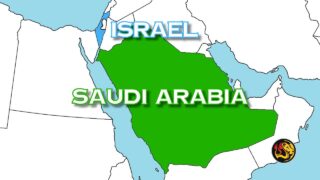
By Stefan J. Bos, Chief International Correspondent Worthy News
RIYADH/JERUSALEM (Worthy News) – Saudi Arabia has softened its position on Palestinian statehood, telling Washington that “a public commitment” from Israel to a two-state solution “could be enough” for the Gulf kingdom to normalize relations with the Jewish nation, according to Saudi and Western officials.
In remarks Friday, the officials also announced that Riyadh abandoned its pursuit of an “ambitious defense treaty” with Washington and sought “a more modest military cooperation agreement” in return for regular ties with Israel.
According to Western diplomats familiar with his thinking, Israeli Prime Minister Benjamin Netanyahu views normalization with Saudi Arabia as a historical milestone and a sign of broader acceptance in the Arab world.
But he faces opposition at home to any concessions to Palestinians in Gaza following the October 7, 2023 Hamas attacks that killed some 1,200 people.
And with public anger in Saudi Arabia and the broader Middle East mounting over Israel’s strikes against Hamas in Gaza, Saudi Crown Prince Mohammed bin Salman has again made recognition of Israel conditional on it taking concrete steps to create a Palestinian state.
Yet, with U.S. President-elect Donald J. Trump soon becoming dealmaker-in-chief, Riyadh and Washington hope a more modest defense pact could be sealed before Joe Biden leaves the White House on January 20.
A full-blown U.S.-Saudi treaty would need to pass the U.S. Senate with a two-thirds majority, and this would be a non-starter unless Riyadh recognizes Israel, several sources said.
However, Trump has made it clear that he wants to extend the Abraham Accords, which already include agreements on Arab–Israeli normalization between Israel and the United Arab Emirates and between Israel and Bahrain, on September 15, 2020.
Copyright 1999-2026 Worthy News. This article was originally published on Worthy News and was reproduced with permission.
Latest News from Worthy News

Europe’s record-breaking heatwaves are exposing vulnerabilities in electricity systems increasingly dependent on weather-driven renewable energy as part of the European Union’s green agenda.
Two Christians, including a young man and a father of four, have been killed in separate attacks in Pakistan, highlighting growing concern about violence and discrimination facing the Christian minority in the Islamic nation, well-informed sources told Worthy News on Sunday.
Lake Mead has fallen to its lowest level since the massive reservoir was filled nearly 90 years ago, underscoring the growing strain on the Colorado River system that supplies water and electricity across much of the American West.

Two former NBA players are seeking to put the transgender-athlete debate to a real-world test, declaring their intention to enter the 2027 WNBA Draft as questions intensify over who should be eligible to compete in women’s professional basketball.
After days of drawn-out negotiations, the U.S. Senate overwhelmingly passed a short-term government funding stopgap early Saturday morning.
The Trump administration is pressing Egypt to protect religious freedom amid mounting concerns over attacks, imprisonment and discrimination targeting the country’s large Christian community, including converts from Islam and members of the ancient Coptic Church.
Iran has dramatically expanded its conditions for reopening the Strait of Hormuz, demanding that the United States withdraw its forces from the Middle East, lift sanctions, release frozen Iranian assets and fully compensate Tehran for damage suffered during the war.