
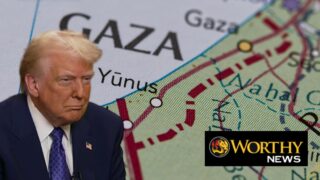
by Emmitt Barry, with reporting from Worthy News Jerusalem Bureau Staff
(Worthy News) – While Hamas publicly declared its willingness to accept major portions of President Donald Trump’s peace initiative, deep divisions within the group threaten to derail what could be the most significant breakthrough since the war began nearly two years ago.
In statements released Friday, Hamas said it was ready to release all Israeli hostages and hand over Gaza to a temporary technocratic administration — key conditions in Trump’s 20-point peace plan. But inside the organization, infighting between political and military factions has stalled consensus on two crucial issues: disarmament and the timeline for releasing hostages.
Arab mediators told the Wall Street Journal that Hamas’s political leadership in exile, led by Khalil al-Hayya, supports accepting Trump’s terms. Yet their influence inside Gaza remains limited, with power concentrated in the hands of Ezzedin al-Haddad, who succeeded the slain Sinwar brothers in commanding Hamas’s military wing.
Haddad reportedly signaled readiness to surrender heavy weaponry such as rockets to Egypt or the United Nations for storage, but insisted on keeping small arms, calling them “defensive.” Gaza-based field commanders, however, have warned they cannot control thousands of younger fighters who see disarmament as surrender.
“Many of them lost family and homes. They won’t easily lay down their rifles,” one mediator said.
‘A 72-Hour Truce, Not Peace’
Hamas’s statement stopped short of the explicit disarmament required by Trump’s plan, prompting U.S. lawmakers to call it a “conditional acceptance.” Senator Lindsey Graham described it as “a classic ‘Yes, but’ response.”
The group’s internal critics have mocked the proposal as “a 72-hour truce,” not a genuine peace deal, reflecting persistent distrust of Israel. Hamas’s official reply also tied any hostage release to “conditions on the ground,” meaning Israeli troop withdrawals and guarantees of ceasefire enforcement.
From Israel’s side, Prime Minister Benjamin Netanyahu cautiously endorsed Trump’s framework but vowed to maintain a defensive posture until hostages are safely returned. “Israel will prepare for their release and work with the president to end the war — on our terms,” Netanyahu said Saturday.
Trump, meanwhile, insisted Hamas “is ready for lasting PEACE,” urging Israel to halt bombing operations “to make the battlefield safe for the hostages.” He dispatched envoys Jared Kushner and Steve Witkoff to Cairo to finalize implementation details with Egyptian mediators.
In a social media post, Trump wrote: “When Hamas confirms, the ceasefire will be immediately effective, the Hostages and Prisoner Exchange will begin, and we will create the conditions for the next phase of withdrawal, which will bring us close to the end of this 3,000-year catastrophe.”
Fragile Unity, Uncertain Future
Despite Trump’s optimism, regional officials warn Hamas’s fractured leadership could sabotage implementation. Rival factions are vying for influence as Gaza’s hierarchy collapses under Israeli pressure. The group’s political bureau has been decimated by airstrikes, while clan militias and competing Islamist factions now control parts of the territory.
Israel Hayom reported that Hamas sidestepped the most sensitive clauses of the Trump plan — including exile for senior leaders, disarmament enforcement, and the deployment of an international stabilization force — pushing them instead into the ambiguous realm of “intra-Palestinian dialogue.”
On the ground, Israel’s military claims Hamas is “battered but not broken.” Thousands of its younger, poorly trained recruits have devolved into smaller independent cells engaging in guerrilla warfare.
Still, some observers believe the negotiations mark a turning point. “Maybe for the first time, Hamas is starting to understand they will be eradicated,” said retired Israeli general Amir Avivi.
Talks in Cairo
Delegations from both sides arrived in Egypt Sunday night to begin negotiations. Israel’s team, led by Strategic Affairs Minister Ron Dermer, will work alongside Hamas’s delegation headed by al-Hayya. Mediators from Qatar, Egypt, and Turkey have warned that if Hamas rejects the plan, they may withdraw diplomatic support.
Under Trump’s framework, Israel would gradually withdraw troops, release 250 prisoners serving life terms, and free more than 1,700 Gazans detained since October 7, 2023. Hamas would disarm, renounce governance, and allow an Arab-led stabilization force to oversee Gaza’s transition.
Trump said he expects the “first phase” — hostage releases and a verified ceasefire — to be completed this week. “TIME IS OF THE ESSENCE,” he warned. “Or massive bloodshed will follow.”
Copyright 1999-2026 Worthy News. This article was originally published on Worthy News and was reproduced with permission.
Latest News from Worthy News

Thousands of Hungarians rallied outside Budapest’s Sándor Palace on Thursday in protest against Prime Minister Péter Magyar, whom they accuse of undermining democracy through planned constitutional changes that would pave the way for removing President Tamás Sulyok from office.

Israel has provided the United States with new intelligence indicating that Iran may be developing a fresh plan to assassinate President Donald Trump, according to people familiar with the matter cited by The Wall Street Journal.

President Donald Trump is pressing congressional Republicans to move quickly on two of his biggest unfinished priorities: a $350 billion defense funding package and a sweeping nationwide voter ID mandate.

Tens of thousands of Christians have been killed in Nigeria over the past six years, many in attacks blamed on radicalized Fulani militant groups, according to a new report by the Observatory for Religious Freedom in Africa.

President Donald Trump’s Board of Peace is preparing pilot “humanitarian zones” in southern Gaza aimed at sheltering vetted Palestinian civilians outside Hamas control, according to a source familiar with the planning.

President Donald Trump closed a tense NATO summit Wednesday by hailing what he called “tremendous unity” inside the alliance, even after delivering blunt warnings to Spain, renewing his push for U.S. control of Greenland, and announcing a major step to strengthen Ukraine’s air defenses against Russia.

President Donald Trump used the closing press conference of the NATO summit in Ankara to deliver one of his sharpest warnings yet about communism, saying the ideology is gaining ground in the United States and abroad and poses a grave danger to American liberty.