
By Stefan J. Bos, Chief International Correspondent Worthy News
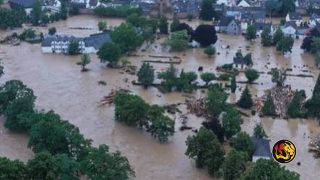
BUDAPEST (Worthy News) – Central and Eastern Europe’s death toll climbed to at least 14 on Monday as Storm Boris, accompanied by heavy rainfall and related flooding, ravaged the region. Romania and Poland were among the heaviest-hit nations.
Across Central and Eastern Europe, rescue workers have been searching for survivors as extreme weather knocked out power and destroyed homes and dams while killing more than a dozen people.
Authorities said Monday that some communities were cut off four days into the disaster.
Since Friday, high winds and unusually heavy rainfall have hit regions in Austria, the Czech Republic, Germany, Hungary, Romania, and Slovakia.
In the Czech Republic, where some 119,000 households, mainly in the northeast, are without electricity, authorities desperately try to save lives amid heavy flooding. Stranded residents are rescued by helicopter.
Similar scenes were seen in Poland, where scores of patients in a hospital in the southwestern town of Nysa are among the thousands being rushed to safety, though one doctor passed away there.
WATER RISING
And water levels keep rising in the Czech Republic, where many still remember the dozens who died in previous flooding.
Despite rescue efforts, numerous people remain missing, and people have also drowned in Austria, Poland, and Romania.
“It destroyed everything. I don’t have anything left,” an elderly Romanian woman said in an already impoverished area.
“The beds are filled with mud, the pillows are filled. I have nowhere to sleep. There is nothing, nothing, nothing,” she added.
In the northwest of neighboring Hungary, the government deployed more than 350 soldiers to reinforce flood barriers as the Danube and rivers along its way are expected to surge, including in the capital, Budapest.
There is debate about what caused the impact of flooding on populations in central and eastern Europe. Several scientists blame climate change, while other experts also blame extensive construction near rivers and a lack of adequate water management for the unfolding drama.
Copyright 1999-2026 Worthy News. This article was originally published on Worthy News and was reproduced with permission.
Latest News from Worthy News

Iran’s Supreme Leader Mojtaba Khamenei’s statement following the signing of a memorandum of understanding with the United States is being viewed by analysts not as an embrace of peace, but as a carefully crafted declaration that preserves Tehran’s revolutionary posture while allowing the regime to regroup.

The United States imposed new sanctions Thursday on individuals and entities linked to Hezbollah, accusing them of using political and financial influence to obstruct Lebanon’s peace process and delay the Iran-backed group’s disarmament.

Ukraine launched one of its largest drone attacks on Moscow since the war began, hitting a key oil refinery and other targets around the Russian capital, leaving at least one person dead and numerous others injured, Russian officials said.

Russian President Vladimir Putin hosted Southeast Asian leaders in Kazan this week as Moscow moved to deepen ties with the Association of Southeast Asian Nations and promote its vision of a “multipolar world order” aimed at countering U.S. global dominance.

Israeli Prime Minister Benjamin Netanyahu said Thursday that Israeli troops will not withdraw from southern Lebanon and will maintain a security zone there for as long as Israel’s defense needs require, placing Jerusalem at odds with both Tehran and the terms of a U.S.-Iran memorandum that calls for an end to hostilities in Lebanon.

U.S. Defense Secretary Pete Hegseth told NATO leaders Thursday that the Pentagon is launching a six-month review of U.S. force posture and basing in Europe, signaling a major push by the Trump administration to ensure European allies assume primary responsibility for defending the continent.

President Donald Trump has invoked the Cold War-era Defense Production Act to accelerate the production of U.S. munitions, missiles, interceptors, and critical defense components as American stockpiles face mounting strain from the war with Iran and years of heavy weapons transfers to allies, including Ukraine and Israel.