
By Stefan J. Bos, Chief International Correspondent Worthy News
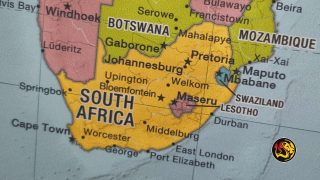
CAPE TOWN (Worthy News) – Cyril Ramaphosa faced major security and social challenges Saturday after being reelected for a second term as South Africa’s president, despite major corruption scandals that underscored the nation’s fragile post-apartheid political era.
Ramaphosa, the leader of the African National Congress (ANC), won convincingly in Parliament after his party struck a late coalition deal with a former political foe just hours before the vote.
He ran against a surprise candidate who was also nominated — Julius Malema of the far-left Economic Freedom Fighters. Ramaphosa received 283 votes to Malema’s 44 in the 400-member house.
The 71-year-old Ramaphosa secured his second term with the help of lawmakers from the country’s second-biggest party, the Democratic Alliance, and some smaller parties.
They backed him in the vote and got him over the finish line following the ANC’s loss of its long-held majority in a landmark election two weeks ago that reduced it to 159 seats in Parliament.
The scandals surrounding the ANC leader seemed all but forgotten after an inquiry found evidence of possible “serious misconduct” relating to a baffling “Farmgate” scandal involving a heist, a Sudanese businessman, and a sofa stuffed with cash.
The panel concluded that he may have broken anti-corruption laws over the 2020 theft of $580,000 stored in a sofa at his Phala Phala game farm.
THEFT OCCURRED
The three-member panel, appointed by the speaker of South Africa’s National Assembly, recommended that Ramaphosa be investigated for possible impeachment. It found in late 2022 “substantial doubt about the legitimacy of the source of the currency that was stolen.”
Ramaphosa admitted that the theft occurred but said it was a payment from selling buffalo to a Sudanese citizen, Mustafa Mohamed Ibrahim Hazim, in late 2019.
Yet it underscored broader concerns about politicians allegedly enriching themselves in a country where many live below the poverty line, three decades after “apartheid,” the segregation or discrimination on the grounds of race, officially ended in South Africa.
However, following the death of the late President and anti-apartheid icon Nelson Mandela, growing tensions emerged between the white minority and the Black majority.
The ANC leader had called for a national unity government after his party lost its absolute majority in last month’s general election, but two major leftist parties shunned the deal.
And ANC Secretary General Fikile Mbalula pledged that the government would “gravitate to the center” — backed by the center-right Democratic Alliance (DA), the Zulu nationalist Inkatha Freedom Party (IFP), and several smaller parties.
“We have reached a breakthrough on the common agreement that we need to work together,” Mbalula told a news conference in Cape Town.
DISPUTED VOTE
He confirmed that the radical leftist Economic Freedom Fighters (EFF) had refused to join what he still called a unity government.
Graft-tainted former president Jacob Zuma’s new electoral vehicle, the uMkhonto weSizwe (MK), has disputed the May 29 election results.
Yet Ramaphosa is still expected to be sworn in next week in Pretoria and then unveil his new cabinet, presumably including ministers from both the ANC and the former opposition parties, confirmed Christian South African journalist Tamás S. Kiss.
“Yes, I believe Ramaphosa is not perfect, but gradually getting rid of the “c(ANC)er” holding back the ANC from becoming a truly reformed democratic South African party, instead of a gravy train party of outlaws,” he told Worthy News.
“In coalition with the DA, the Ramaphosa can perhaps now bring proper service delivery and much-needed progress. It’s clear that he’s not in politics for the money; he has enough of it already,” he added.
“Now is the time for him to prove what he can do for South Africa and become a legend for future generations. If he fails, it will be just another chapter in the history books of failed ANC politicians.”
They will face significant issues ranging from high unemployment to fighting crime.
HIGH UNEMPLOYMENT
The joblessness rate stood at 32.4 percent last year, nearly 10 points higher than in 1994 when the ANC came to power.
Young people account for more than half of the country’s unemployed, with a rate of over 40 percent, according to official data.
South Africa, a nation of 61 million people, also has one of the world’s highest rates of violent crime, making it unsafe to venture into specific neighborhoods.
The problem is worse in the densely populated townships on the peripheries of cities where many Black working class people live, observers say.
The murder rate for 2022-2023 was the highest in 20 years at 45 per 100,000, a 50 percent increase from a decade ago, police figures show. That is higher than in Honduras, a country plagued by extreme gang violence.
That, combined with massive immigration, corruption, and “load-shedding” scheduled power cuts imposed by state utility Eskom due to its inability to generate enough electricity, are ingredients for turbulent political years. “However, I hope Ramaphosa becomes the obvious rainbow after the storm in our Rainbow Nation,” said Kiss, the journalist.
Copyright 1999-2026 Worthy News. This article was originally published on Worthy News and was reproduced with permission.
Latest News from Worthy News

President Donald Trump warned Friday that the United States may soon strike Iran’s Pickaxe Mountain, a deeply fortified underground site near the Natanz uranium enrichment complex, as tensions over Tehran’s nuclear program continue to sharpen.
The United States, Britain, France, and Germany are pressing the International Atomic Energy Agency’s Board of Governors to report Iran to the U.N. Security Council, accusing Tehran of violating its nuclear obligations and refusing to fully account for its enriched uranium stockpile.
Israeli Prime Minister Benjamin Netanyahu declared that removing Iran’s ruling regime has become Israel’s “central mission,” telling senior military officials that the goal is now “within reach” as Tehran faces mounting pressure from Israel, the United States, and regional fallout from its terror network.
A new U.S.-Saudi civilian nuclear agreement could eventually give Riyadh a pathway to enrich uranium up to 20%, raising fresh concerns in Washington over nuclear proliferation in the Middle East, according to a Wall Street Journal exclusive.

The Israel Defense Forces said Thursday it had completed clearing a strategic Hezbollah underground facility beneath the Ali Taher Ridge in southern Lebanon and was preparing the tunnel complex for demolition.

Syria has begun destroying chemical weapons materials left behind by the Assad regime, marking the first known destruction process of its kind in the country in roughly a decade, officials told the U.N. Security Council on Thursday.

U.S. lawmakers are raising fresh concerns that China, Russia and other American adversaries could use electromagnetic pulse weapons to cripple the nation’s electrical grid and critical infrastructure, potentially plunging large portions of the country into darkness.