
by Emmitt Barry, with reporting from Washington D.C. Bureau Staff
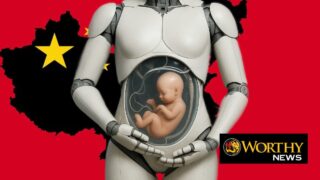
BEIJING (Worthy News) – A Chinese technology company has announced bold plans to release what it calls the world’s first gestation robot–a humanoid machine designed to carry a baby in an artificial womb embedded within its abdomen.
Kaiwa Technology, based in Guangzhou, says the prototype will be ready within a year and could hit the market by 2026 at a price below 100,000 yuan (around $13,900). Founder Zhang Qifeng, who is also affiliated with Nanyang Technological University, presented the project at the 2025 World Robot Conference in Beijing, where it sparked widespread debate over science, ethics, and human dignity.
Humanoid Birth Machine
The robot is envisioned as a life-sized humanoid with a transparent abdominal chamber functioning as an artificial womb. A fetus would grow inside a fluid-filled sac, receiving nutrients through a tube system designed to mimic natural pregnancy.
“It is not merely an incubator but a life-sized humanoid equipped with an artificial womb in its abdomen, capable of replicating the entire process from conception to delivery,” Zhang told Chinese media.
Zhang claimed the technology is already mature in lab conditions but requires integration into a humanoid form for “human-robot interaction” during pregnancy. He also said proposals have been submitted to Guangdong provincial authorities for policy and legal approval.
Scientific Basis and Obstacles
Artificial womb experiments are not entirely new. In 2017, researchers at the Children’s Hospital of Philadelphia successfully kept a premature lamb alive for four weeks inside a so-called “biobag,” where it grew wool and developed normally. But such systems have only supported partial gestation, functioning more like neonatal incubators.
Zhang’s claim–that his robot could sustain life from conception through birth–remains unproven. Critics note that such a leap would require solving immense challenges in fertilization, implantation, and long-term fetal development.
Ethical Storm
The proposal has ignited heated discussions worldwide. Advocates hail it as a breakthrough for couples struggling with infertility, while critics warn of commodifying human life. Christian leaders and pro-life advocates argue that the technology risks treating children as manufactured products rather than God-given blessings.
Scripture reminds believers that children are “a heritage of the Lord” (Psalm 127:3), a truth that machines cannot replicate, no matter how advanced. For many, the pregnancy robot raises more profound questions about whether humanity is attempting to play God by replacing natural motherhood with robotic surrogacy.
AI Breeding Factories
The World Robot Conference also showcased another headline-grabbing innovation: the GEAIR robot, an AI-powered system developed by the Chinese Academy of Sciences to cross-pollinate crops and accelerate hybrid seed production. Researchers say the technology could revolutionize agriculture by dramatically cutting breeding cycles and boosting yields.
Together, these innovations reveal Beijing’s accelerating push to merge artificial intelligence with biotechnology — both in food production and, increasingly, in human life itself.
Copyright 1999-2026 Worthy News. This article was originally published on Worthy News and was reproduced with permission.
Latest News from Worthy News

A federal appeals court on Tuesday temporarily allowed the Trump administration to continue collecting its 10% global tariff, pausing a lower-court ruling that found the import duties unlawful for three plaintiffs who had won relief last week. The U.S. Court of Appeals for the Federal Circuit issued a short-term administrative stay while it considers whether to keep the tariffs in place during the government’s appeal.
Saudi Arabia launched covert airstrikes inside Iran during the recent Middle East war, according to a Reuters exclusive citing two Western officials and two Iranian officials — a move that, if confirmed, would mark the first known Saudi military action carried out directly on Iranian soil. The reported strikes came in late March after the kingdom suffered Iranian attacks, including missile and drone strikes that exposed vulnerabilities in the U.S.-backed security umbrella protecting Gulf Arab states.

Russian President Vladimir Putin announced Tuesday that Russia had successfully test-fired its new Sarmat intercontinental ballistic missile — nicknamed “Satan II” by NATO — declaring it the most powerful missile in the world and saying it would enter combat service by the end of 2026.

Hungary’s new government signaled Monday it will continue buying Russian energy despite European Union plans to phase out imports of Russian oil and natural gas, raising the prospect of an early confrontation with Brussels.

More than 100 new evangelical churches have reportedly opened and thousands of people have been baptized in Ukraine since Russia launched its full-scale invasion of the country in February 2022, church leaders say.

Hezbollah Secretary-General Naim Qassem said an agreement between Iran and the United States may be the best path to ending Israeli military operations in Lebanon, while defiantly rejecting any outside demand that the Iranian-backed terrorist group disarm.

U.S. federal prosecutors announced criminal charges Tuesday against the operator of the cargo ship that struck and destroyed Baltimore’s Francis Scott Key Bridge in 2024, killing six construction workers.