
by Emmitt Barry, Worthy News Correspondent
(Worthy News) – China on Monday warned it will retaliate against countries that align with the U.S. in ways that harm Beijing’s interests, as the escalating trade war between the world’s two largest economies increasingly entangles other nations. Beijing specifically cautioned against trade agreements with Washington that come at China’s expense, vowing countermeasures in response.
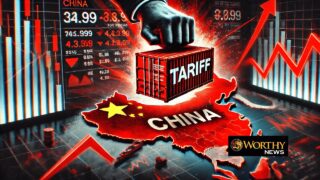
China’s warning follows reports that President Trump plans to use tariff talks to pressure U.S. partners to curb ties with Beijing. This month, he paused tariff hikes on other countries for 90 days but raised duties on Chinese goods to 145%.
In response to the steep U.S. tariff hikes, China’s Ministry of Commerce said Beijing “respects all parties’ efforts to resolve their trade disputes with the US through equal consultation.”
However, Beijing warned it will “respond resolutely and reciprocally with countermeasures” to any U.S.-led trade deals that undermine its interests.
“China firmly opposes any party reaching a deal at the expense of China’s interests. If this happens, China will not accept it and will resolutely take reciprocal countermeasures,” the Ministry of Commerce of China stated.
China condemned the tariffs as “unilateral bullying,” adding, “if international trade regresses to the law of the jungle where the strong prey on the weak, all countries will become victims.”
Last week, the Trump administration reportedly aimed to pressure U.S. trade partners to limit deals with China, warning of possible secondary tariffs.
At the same time, Chinese President Xi visited key Southeast Asian partners—Vietnam, Malaysia, and Cambodia—on his first trip of the year, signaling a push for “regional stability and prosperity” and support for economic integration amid rising global protectionism, according to Xinhua.
China recently imposed export restrictions on a broad range of rare earth minerals, with a clear focus on the U.S.
Just days later, President Trump signed an executive order to investigate critical mineral imports, stating: “Critical minerals, including rare earth elements, in the form of processed minerals, are essential raw materials and critical production inputs required for economic and national security.”
Last week, President Trump revealed that Chinese officials have contacted the U.S. “a number of times” since the trade war began, indicating ongoing behind-the-scenes communication. When asked Thursday in the Oval Office about contact following the latest tariffs, Trump said, “Oh sure, a lot. A lot. All the time. We’re talking.”
He declined to confirm if he had personally spoken with President Xi, adding, “We will talk about that soon. It’s not that important because honestly we’re going to have a deal. I believe we’re going to have a deal with China and if we don’t, we’re going to have a deal anyway, because we’re gonna set a certain target and that’s going to be it.”
Copyright 1999-2026 Worthy News. This article was originally published on Worthy News and was reproduced with permission.
Latest News from Worthy News

President Donald Trump abruptly canceled planned U.S. strikes against Iran on Thursday, saying a multinational agreement to end the conflict had been approved by top Iranian leadership and was awaiting final documents and a formal signing.

Federal authorities said Thursday they have accounted for 146,000 unaccompanied migrant children who entered the United States during former President Joe Biden’s administration, while roughly 300,000 minors remain unaccounted for, amid allegations that many vulnerable children were placed with fraudulent sponsors and exposed to abuse, labor exploitation, and sex trafficking.

Congress left Washington without renewing Section 702 of the Foreign Intelligence Surveillance Act, allowing a key foreign surveillance authority used to track foreign terrorists and national security threats to expire Friday.

The U.S. Court of Appeals for the Federal Circuit on June 11 temporarily allowed President Donald Trump’s 10 percent global tariffs to remain in effect, extending a pause on a lower court ruling that had struck down the duties as unlawful.

Dutch police detained a young man l man after four people, including three children, were killed when a car struck a group of cyclists during a school outing near the Belgian border on Thursday, officials said.

The leaders of Hungary, Poland, the Czech Republic, and Slovakia are expected to meet this month amid growing debate within the European Union over how future member states should be admitted and monitored.

China has condemned the European Union’s ban on public funding for Chinese-made solar inverters, a move that analysts say could affect more than a fifth of new solar capacity and complicate efforts to meet the bloc’s self-imposed “climate targets.”