
by Stefan J. Bos, Worthy News Europe Bureau Chief
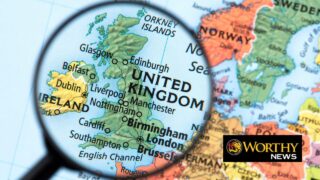
LONDON/BUDAPEST (Worthy News) – Britain is facing calls for stronger safeguards on the planned use of facial recognition cameras across the country after the Home Office admitted the system is more likely to incorrectly identify black and Asian people than their white counterparts.
The controversy added to concerns that the cameras, used in cities, towns, and villages across the nation, will lead to a Big Brother “dystopian nightmare.”
Some Bible experts say the system resembles an era of the Beast when the anti-Christ will rule the world for seven years.
Following the latest testing conducted by the National Physical Laboratory (NPL) of the technology’s application within the police national database, the Home Office said it was “more likely to incorrectly include some demographic groups in its search results”.
POLICE LEADERS URGE CAUTION
Police and crime commissioners said publication of the NPL’s findings “sheds light on a concerning inbuilt bias” and urged caution over plans for a national expansion.
The findings were released on Thursday, hours after Sarah Jones, the policing minister, had described the technology as the “biggest breakthrough since DNA matching”.
Facial recognition technology scans people’s faces and then cross-references the images against watchlists of known or wanted criminals.
It can be used while examining live footage of people passing by cameras, comparing their faces with those on wanted lists, or by officers to target individuals as they walk past mounted cameras.
POLICE, PASSPORT, AND IMMIGRATION
Images of suspects can also be run retrospectively through police, passport, or immigration databases to identify them and check their backgrounds.
Analysts who examined the police national database’s retrospective facial recognition technology tool at a lower setting found that “the false positive identification rate (FPIR) for white subjects (0.04%) is lower than that for Asian subjects (4.0%) and black subjects (5.5%)”.
The testing went on to find that the number of false positives for black women was exceptionally high. “The FPIR for black male subjects (0.4%) is lower than that for black female subjects (9.9%),” the report said.
The revelations sparked an immediate backlash from rights groups and several lawmakers, who warned that the government risks embedding discriminatory technology into everyday policing.
CIVIL LIBERTIES UNDER PRESSURE
Civil-liberties organizations such as Big Brother Watch said the data confirms that minority communities will face disproportionate scrutiny, potentially leading to wrongful arrests and further erosion of trust in law enforcement.
Despite these concerns, ministers have signaled they intend to press ahead with a nationwide rollout, arguing that facial recognition has already helped capture violent criminals and missing persons.
They stress that safeguards will be strengthened as accuracy improves.
However, critics counter that the United Kingdom is moving toward one of the most expansive biometric-surveillance regimes in the democratic world. They fear the technology could normalize continuous monitoring of the population, with cameras deployed in transport hubs, shopping centers, public gatherings, and even rural communities.
Several legislators have called for Parliament to impose strict legal limits, warning that without robust oversight, the technology could undermine fundamental freedoms and accelerate a shift toward a surveillance state.
Copyright 1999-2026 Worthy News. This article was originally published on Worthy News and was reproduced with permission.
Latest News from Worthy News

The U.S. Senate late Wednesday rejected a Democratic-led effort to restrict President Donald Trump’s military authority against Iran, handing the White House a significant victory as the administration continues negotiations with Tehran.

U.S. Secretary of Defense Pete Hegseth said the first milestone test of Golden Dome for America was a “full mission success,” calling it a major step toward President Donald Trump’s goal of building a next-generation shield to defend the American homeland.
Rescuers raced to find survivors Thursday after two powerful earthquakes shook the Venezuelan capital, Caracas, seconds apart, killing dozens and injuring hundreds.

President Donald Trump is expected to meet Thursday at the White House with senior executives from major U.S. defense companies as his administration seeks to accelerate weapons production following the war with Iran and other conflicts that have strained Pentagon stockpiles.

U.S. Secretary of State Marco Rubio confirmed Wednesday that Israel and Lebanon are discussing a possible scale-back of Israeli troops from southern Lebanon as part of U.S.-mediated negotiations in Washington.

Canadian police have warned of possible copycat attacks after a deadly shooting in Montreal left three people dead, including a police officer, and a manifesto linked to the gunman was circulated online.

A deadly heatwave tightened its grip on Europe Wednesday, sending temperatures soaring to record levels, straining power grids, disrupting transport, and raising fears of additional casualties across the continent.